
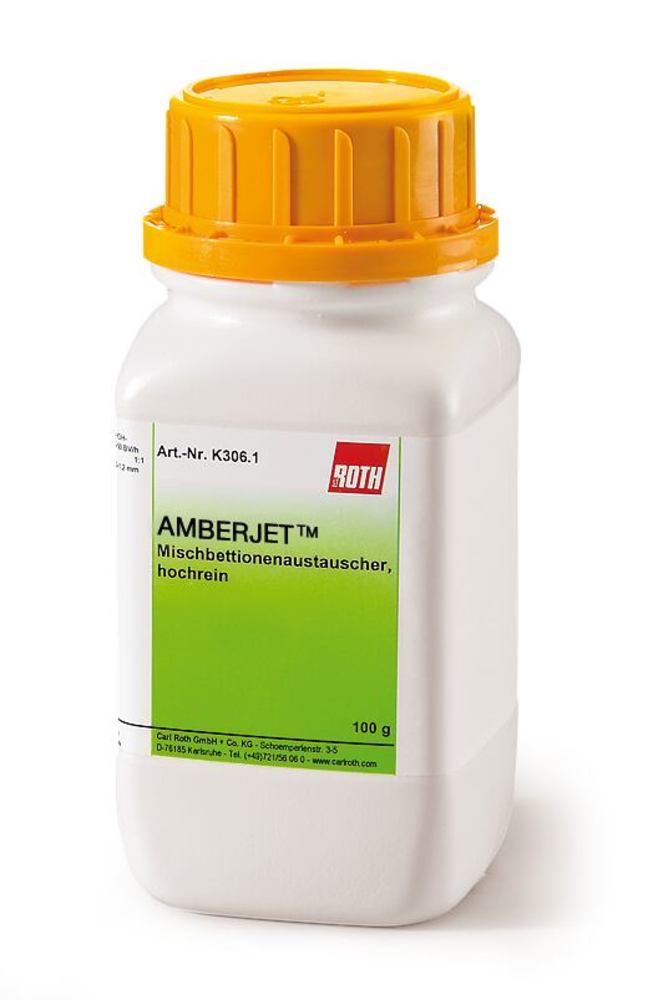


Description
Amberjet™ is a highly pure mixed bed ion exchanger intended for laboratory deionization and related ion-exchange applications. The material shows a density in the range of 1,09 to 1,25 g/cm³. As a mixed bed exchanger it brings cation- and anion-exchange capacity together in one medium, supporting preparation of high-purity water and reduction of ionic load in aqueous samples. Typical settings include analytical sample preparation, polishing steps after primary purification, and small-column or batch treatments where residual ions must be kept low. This grade belongs to the Amberjet™ ion exchanger family from manufacturer Carl ROTH and aligns with sorbent and filter-media workflows in research and quality-control laboratories. High purity helps limit background conductivity and supports reproducible exchange performance when standard ion-exchange practice is followed. The compact pack size suits method development, teaching laboratories, and routine maintenance of laboratory water systems without excess inventory.
This article is part of Sorbents, silica gel & ion exchangers, in SPE & sample preparation.
Key features
- Delivery form: H+/OH-
- Blend ratio: 0,90-1,10
- Particle size: 0,3-1,2 mm
- Pack sizes: 100 g, 500 g
- Density: 1,09 to 1,25 g/cm³
- Product type: mixed bed exchanger
- Grade: highly pure
- Technical Information Sheet:

- Safety Data Sheet:
Recently viewed
You may also like
Browse related categories
Category
Sub-category
Sorbents, silica gel & ion exchangers
Catalogue
Brand
Questions about Amberjet TM, mixed bed exchanger, highly pure, 100 g, plastic
What is this article?
Amberjet TM, mixed bed exchanger, highly pure, 100 g, plastic is the article on this page. Luminix Health distributes Carl Roth for laboratory use. It sits in Sorbents, silica gel & ion exchangers, inside SPE & sample preparation, in Chromatography equipment.
Loose sorbent, silica gel and ion-exchange resin are the phases bought in bulk to pack a column or to stir into a solution. Particle size and activity, or the ion-exchange capacity, are the specification. A TLC silica and a flash silica of different particle sizes are not the same separation.
Solid-phase extraction holds a compound on a sorbent while the rest of the sample is washed away, then releases it in a small volume. The sorbent, the bed mass and the solvents are the method. Silica, ion exchangers and polymer phases do different jobs. A flash column is the same idea scaled toward purification rather than trace cleanup. The molecules are on PubChem, named by IUPAC.
Which category should I open next?
The category is SPE & sample preparation. The sub-category is Sorbents, silica gel & ion exchangers. The catalogue is Chromatography equipment.
Shelves beside this one are SPE cartridges & columns and Flash, empty & glass chromatography columns.
What should I check before I order?
When this page shows a safety data sheet, use that manufacturer file. Hazard text does not belong in the sales description. For a pack size, a grade or a certificate that is not on the page, send a quote request or contact the team.
How does ordering and shipping work?
Luminix Health distributes this article from the heart of Europe. Articles in stock ship within 2–5 business days. Standard delivery is free from €250 excl. VAT. Cold-chain goods and dangerous goods under ADR are never included in that free delivery. The terms are in the Shipping Policy. The full brand index is on shop by brand. Who we are is on about us.
Which other categories should I open?
The seven catalogues are Labware, Lab chemicals, Lab instruments, Lab consumables, Chromatography equipment, Lab safety equipment and Life Science & Microbiology.