



Description
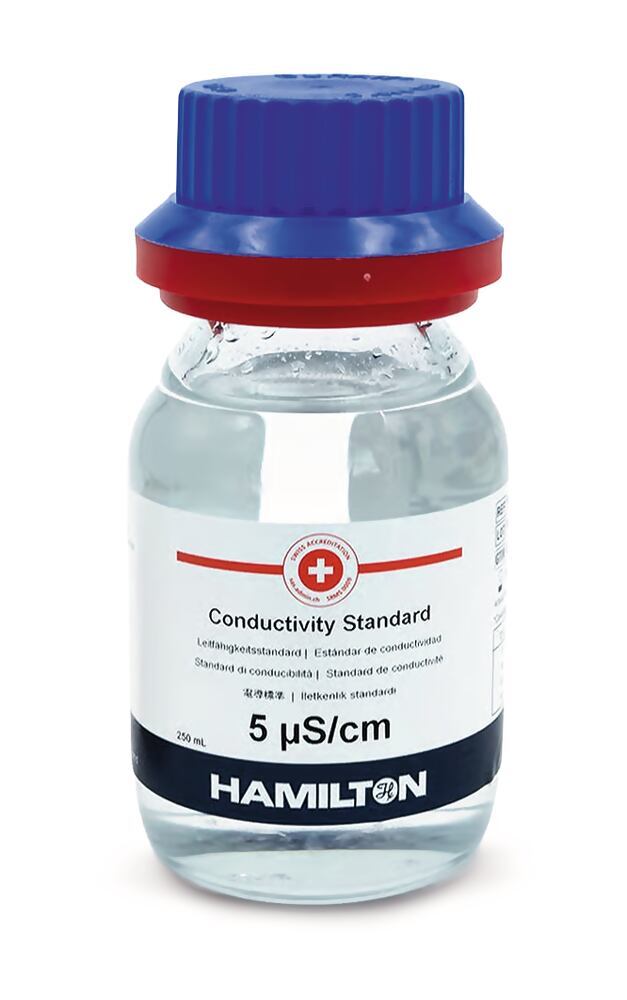
Conductivity Standard Hamilton is a glycerine-based conductivity standard specified at 5 µS/cm (25 °C) for laboratory chemical applications. The article is offered in a 250 ml glass pack and is described as glycerine-based, with a density of 1,2 g/cm³ and a boiling point greater than 100 °C. These figures characterise a liquid standard whose conductivity set-point of 5 µS/cm is referred to 25 °C. The glycerine-based matrix distinguishes this preparation from purely aqueous conductivity solutions and is an integral part of the product identity together with the 5 µS/cm rating. Pack quantity is 250 ml in glass; the stated weight of the unit is 0,401 kg. From manufacturer HAMILTON, the standard sits in the laboratory chemicals assortment as a defined conductivity reference at 5 µS/cm (25 °C). Users requiring a glycerine-based 5 µS/cm standard can match the 250 ml glass presentation to routine conductivity work where that value, density 1,2 g/cm³ and boiling point above 100 °C are the documented physical properties. This rating supports laboratory conductivity measurement where a glycerine-based standard of 5 µS/cm at 25 °C is specified.
This article is part of Conductivity meters & cells, in pH & electrochemistry. See also pH meters.
Key features
- Pack size: 250 ml glass
- Density: 1,2 g/cm³
- Boiling point: >100 °C
- Conductivity: 5 µS/cm (25 °C)
- Matrix: glycerine-based
- Technical Information Sheet:

- Safety Data Sheet:
Recently viewed
You may also like
Browse related categories
Category
Sub-category
Catalogue
Brand
Questions about Conductivity Standard Hamilton, 5 µS/cm (25 °C), glycerine-based, 250 ml, glass
What is this article?
Conductivity Standard Hamilton, 5 µS/cm (25 °C), glycerine-based, 250 ml, glass is the article on this page. Luminix Health distributes Carl Roth for laboratory use. It sits in Conductivity meters & cells, inside pH & electrochemistry, in Lab instruments.
A conductivity meter and its cell measure how well a solution carries current. The cell constant is the geometry that converts conductance to conductivity, and it is calibrated with a standard. Temperature compensation matters because conductivity rises with temperature.
A pH meter is a voltmeter on a glass electrode. The voltage tracks hydrogen-ion activity, and the electrode is converted to pH only after it is adjusted with buffers of known value. Conductivity measures how well a solution carries a current, which for dilute salts tracks concentration. Dissolved oxygen and titration are further electrodes on the same idea: a sensor, a standard, and a reading that is only as fresh as the calibration. Buffer values and chemical identity sit on PubChem. Accreditation of the calibration laboratory is the field of BELAC and EURAMET.
Which category should I open next?
The category is pH & electrochemistry. The sub-category is Conductivity meters & cells. The catalogue is Lab instruments.
Shelves beside this one are pH electrodes & sensors, pH meters, Dissolved oxygen & multiparameter meters, Titrators & electrochemistry systems and pH & electrochemistry accessories.
What should I check before I order?
When this page shows a safety data sheet, use that manufacturer file. Hazard text does not belong in the sales description. For a pack size, a grade or a certificate that is not on the page, send a quote request or contact the team.
How does ordering and shipping work?
Luminix Health distributes this article from the heart of Europe. Articles in stock ship within 2–5 business days. Standard delivery is free from €250 excl. VAT. Cold-chain goods and dangerous goods under ADR are never included in that free delivery. The terms are in the Shipping Policy. The full brand index is on shop by brand. Who we are is on about us.
Which other categories should I open?
The seven catalogues are Labware, Lab chemicals, Lab instruments, Lab consumables, Chromatography equipment, Lab safety equipment and Life Science & Microbiology.