


Description
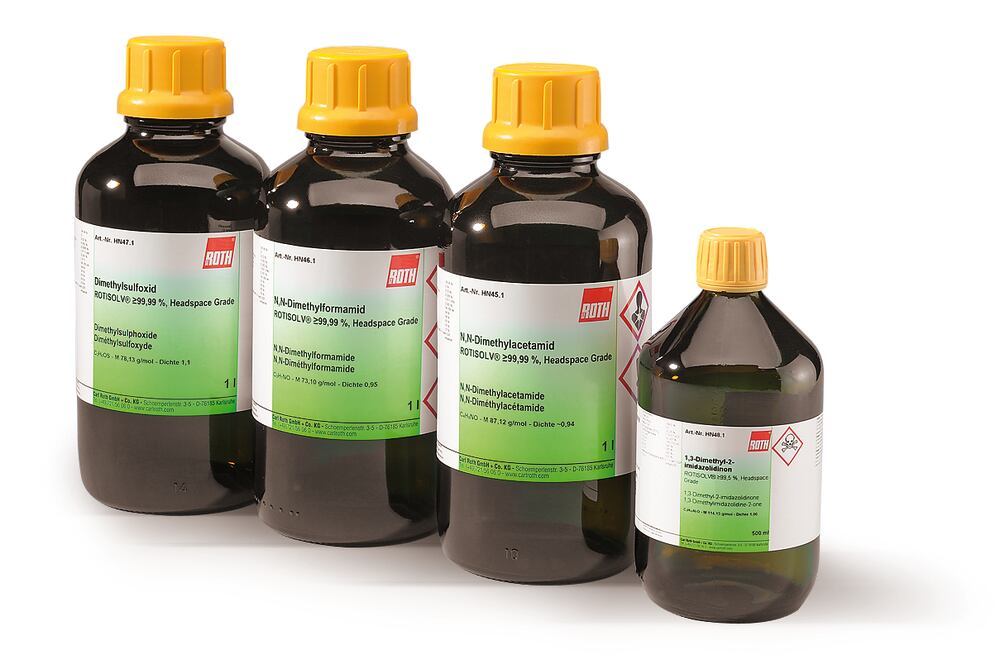
Dimethylsulphoxide ROTISOLV® is a high-purity headspace-grade solvent offered at min. 99,99 % for chromatographic laboratory applications. It carries CAS number 67-68-5 and the empirical formula C₂H₆OS, with a molar mass of 78,13 g/mol and a density of 1,1 g/cm³. The boiling point is 189 °C and the flash point is 87 °C, giving well-defined thermal characteristics for handling and method design. Supplied in a 1 l glass pack, this ROTISOLV® solvent is positioned for gas-chromatographic and headspace work where solvent background must remain minimal. Identity and physical data from manufacturer Carl ROTH support confident integration into analytical protocols. The product suits residual-solvent analysis, sample preparation, and GC methods that rely on consistent purity and known physicochemical behaviour. Laboratories seeking a defined dimethyl sulphoxide grade for headspace chromatography can use this material within established quality and safety frameworks.
This article is part of HPLC & LC-MS grade solvents, in Solvents. See also Analytical grade solvents (p.a.).
Key features
- Assay (GC): ≥99.99 %
- Colour (APHA): ≤5
- Water (KF): ≤0.03 %
- Free acid (as CH3COOH): ≤0.002 %
- Free alkali (as NH3): ≤0.0005 %
- Refractive index (20 °C): 1.477-1.480
- Non volatile matter: ≤0.001 %
- Melting point: ≥18 °C
- UV-Cutoff: 190-265 nm
- 400 nm: ≥98 %
- CAS number: 67-68-5
- Pack size: 1 l glass
- EG nr.: 200-664-3
- Purity: min. 99,99 %
- Molar mass: 78,13 g/mol
- Technical Information Sheet:

- Safety Data Sheet:
Recently viewed
You may also like
Browse related categories
Category
Sub-category
Catalogue
Brand
Questions about Dimethylsulphoxide, ROTISOLV®, min. 99,99 %, Headspace Grade, 1 l, glass
What is this article?
Dimethylsulphoxide, ROTISOLV®, min. 99,99 %, Headspace Grade, 1 l, glass is the article on this page. Luminix Health distributes Carl Roth for laboratory use. It sits in HPLC & LC-MS grade solvents, inside Solvents, in Lab chemicals.
HPLC grade limits the absorbance and the residue that would appear as peaks or baseline drift. LC-MS grade goes further on metal ions and on particles that would suppress a mass spectrum. A solvent that is only analytical grade is a false economy on an LC-MS system.
A solvent dissolves. The grade says which impurities are low enough for the method. Analytical grade is the ordinary pure solvent. HPLC and LC-MS grades limit the absorbance and the ions that would become peaks or background. A dry solvent has had water removed. A deuterated solvent is for NMR, where the hydrogen signal would otherwise drown the sample. Technical grade is for cleaning and for synthesis that does not need a chromatogram. Identity is on PubChem. Names follow IUPAC. Hazards follow ECHA, the CLP Regulation and REACH.
Which category should I open next?
The category is Solvents. The sub-category is HPLC & LC-MS grade solvents. The catalogue is Lab chemicals.
Shelves beside this one are Analytical grade solvents (p.a.), Dry & deuterated solvents (NMR, synthesis), Technical & synthesis grade solvents and Green & alternative solvents.
What should I check before I order?
The technical information on this page is the manufacturer's sheet. Read that, not a rewritten specification.
When this page shows a safety data sheet, use that manufacturer file. Hazard text does not belong in the sales description. For a pack size, a grade or a certificate that is not on the page, send a quote request or contact the team.
How does ordering and shipping work?
Luminix Health distributes this article from the heart of Europe. Articles in stock ship within 2–5 business days. Standard delivery is free from €250 excl. VAT. Cold-chain goods and dangerous goods under ADR are never included in that free delivery. The terms are in the Shipping Policy. The full brand index is on shop by brand. Who we are is on about us.
Which other categories should I open?
The seven catalogues are Labware, Lab chemicals, Lab instruments, Lab consumables, Chromatography equipment, Lab safety equipment and Life Science & Microbiology.