
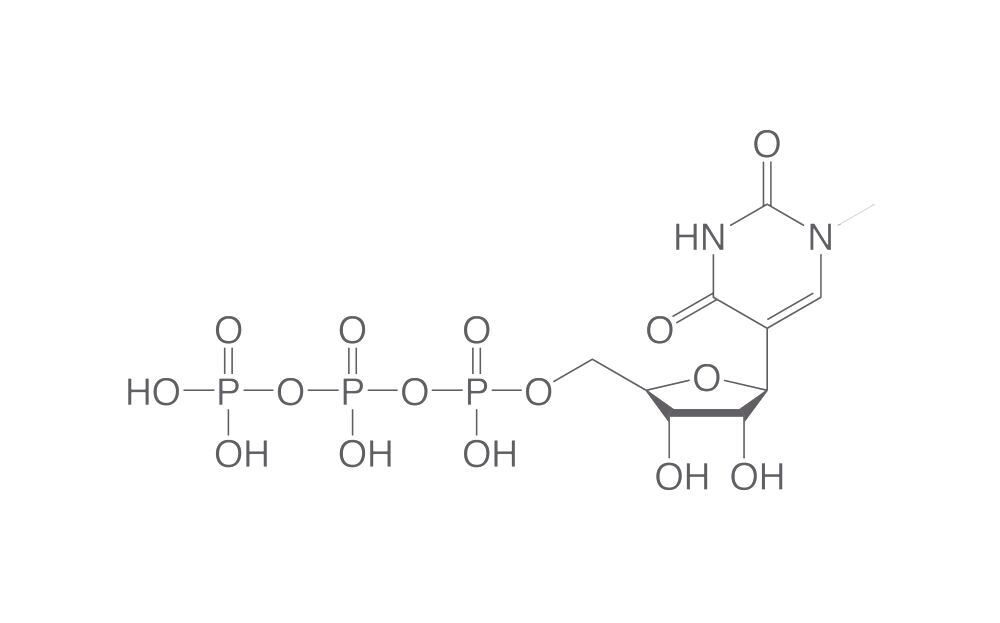



Description
N₁-Methylpseudo-UTP is a methylated pseudouridine triphosphate analogue provided at a minimum purity of 95 % for mRNA synthesis and related nucleotide chemistry. It carries CAS number 1428903-59-6, the empirical formula C₁₀H₁₇N₂O₁₅P₃, a molar mass of 498,10 g/mol and an approximate density of ~1 g/cm³. The N₁-methylpseudouridine motif is widely employed when modified UTP building blocks are required in transcription and click-chemistry-oriented nucleic acid programmes. This product is Sourced from manufacturer baseclick, the reagent offers a defined chemical identity suitable for organic chemistry and mRNA synthesis laboratories. Its documented purity and molecular parameters support reproducible incorporation into established protocols without speculative performance claims. Researchers focusing on modified nucleotide libraries or click-enabled RNA constructs benefit from a compact, clearly labelled unit that simplifies dosing and documentation. N₁-Methylpseudo-UTP thus serves as a straightforward, specification-driven choice for controlled experimental work with pseudouridine-type triphosphates.
This article is part of Coenzymes, nucleotides & vitamins, in Biochemicals & reagents.
Key features
- Purity (HPLC): ≥95 %
- Appearance: colorless solution (100mM, pH 7.5)
- CAS number: 1428903-59-6
- Pack sizes: 10 µl, 50 µl
- Purity: min. 95 %
- Empirical formula: C₁₀H₁₇N₂O₁₅P₃
- Molar mass: 498,10 g/mol
- Density: ~1 g/cm³
- Technical Information Sheet:

- Safety Data Sheet:
Recently viewed
You may also like
Questions about N1-Methylpseudo-UTP, min. 95 %, 10 µl, plastic
What is this article?
N1-Methylpseudo-UTP, min. 95 %, 10 µl, plastic is the article on this page. Luminix Health distributes baseclick for laboratory use. It sits in Coenzymes, nucleotides & vitamins, inside Biochemicals & reagents, in Microbiology lab supplies.
Coenzymes, nucleotides and vitamins are the small molecules enzymes and cells consume: NAD, ATP, a vitamin cofactor. Purity, salt form and hydration are the specification, and many are unstable in solution or in the light. The lot is stored as the label says, often cold.
A biochemical is a molecule of life, sold as a reagent: an amino acid, a sugar, a nucleotide, a lipid, an enzyme, an antibiotic. The difference from a bulk chemical is that the use is a biological one, and the impurities that matter are the ones that change that use. An enzyme is specified by activity, not only by mass. An antibiotic is specified by potency. Papers are on PubMed. Structures are on PubChem. Strains and lines that consume these reagents are at ATCC.
Which category should I open next?
The category is Biochemicals & reagents. The sub-category is Coenzymes, nucleotides & vitamins. The catalogue is Microbiology lab supplies.
Shelves beside this one are Amino acids & peptides, Carbohydrates & sugars, Biochemicals (other), Enzymes & substrates, Antibiotics & antimycotics, Lipids, steroids & fatty acids and Detergents & surfactants.
What should I check before I order?
When this page shows a safety data sheet, use that manufacturer file. Hazard text does not belong in the sales description. For a pack size, a grade or a certificate that is not on the page, send a quote request or contact the team.
How does ordering and shipping work?
Luminix Health distributes this article from the heart of Europe. Articles in stock ship within 2–5 business days. Standard delivery is free from €250 excl. VAT. Cold-chain goods and dangerous goods under ADR are never included in that free delivery. The terms are in the Shipping Policy. The full brand index is on shop by brand. Who we are is on about us.
Which other categories should I open?
The seven catalogues are Labware, Lab chemicals, Lab instruments, Lab consumables, Chromatography equipment, Lab safety equipment and Life Science & Microbiology.