
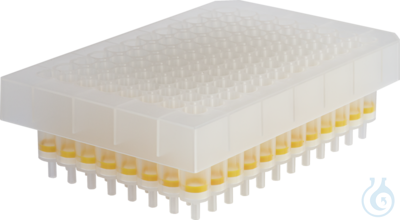



Description
NucleoSpin 96 Flash Filter Plates (24) are 96-well plates intended for clarification of bacterial lysates prior to plasmid or construct purification. Supplied as a pack of 24 plates, they support high-throughput sample preparation where debris and particulate material must be removed efficiently before binding or further processing steps. The multiwell geometry allows parallel clarification of many lysates in a single run, which is valuable in molecular biology and biochromatography workflows that rely on consistent lysate quality. These filter plates from manufacturer Macherey-Nagel integrate into NucleoSpin 96 Flash-type protocols and related plate-based purification schemes, helping laboratories maintain throughput when processing large numbers of bacterial cultures. Each plate is configured for standard 96-well handling, facilitating use with common laboratory automation or manual multiwell routines. The pack of 24 provides ample capacity for repeated clarification cycles in research and routine laboratory settings focused on plasmid isolation and related nucleic-acid preparation tasks.
This article is part of Biological buffers (Tris, HEPES, MOPS), in Buffers & pH solutions.
Key features
- Pack size: 24 plates
- Storage temperature: 18–25 °C
- Format: 96-well filter plates
- Product type: Flash filter plates
- EAN: 4046681159114
Recently viewed
You may also like
Browse related categories
Category
Sub-category
Biological buffers (Tris, HEPES, MOPS)
Catalogue
Brand
Questions about NucleoSpin 96 Flash Filter Plates (24)
What is this article?
NucleoSpin 96 Flash Filter Plates (24) is the article on this page. Luminix Health distributes Macherey-Nagel for laboratory use. It sits in Biological buffers (Tris, HEPES, MOPS), inside Buffers & pH solutions, in Lab chemicals.
Tris, HEPES, MOPS and their relatives hold pH in a range that cells and proteins tolerate, with a pKa near the working pH. The useful range is roughly one unit either side of the pKa. A phosphate buffer and Tris are not interchangeable in a method that names one of them, because the ion itself has effects.
A buffer resists a change in pH when a little acid or base is added. It does that because a weak acid and its conjugate base are both present. A pH buffer used to calibrate a meter has a stated value at a stated temperature. A biological buffer such as Tris or HEPES is chosen because it holds the pH of a living system and does not poison it. Conductivity standards are the sister articles for a conductivity meter. The ions are on PubChem. Electrode calibration practice sits with EURAMET and BELAC.
Which category should I open next?
The category is Buffers & pH solutions. The sub-category is Biological buffers (Tris, HEPES, MOPS). The catalogue is Lab chemicals.
Shelves beside this one are pH buffers & conductivity standards and Buffers (other).
What should I check before I order?
When this page shows a safety data sheet, use that manufacturer file. Hazard text does not belong in the sales description. For a pack size, a grade or a certificate that is not on the page, send a quote request or contact the team.
How does ordering and shipping work?
Luminix Health distributes this article from the heart of Europe. Articles in stock ship within 2–5 business days. Standard delivery is free from €250 excl. VAT. Cold-chain goods and dangerous goods under ADR are never included in that free delivery. The terms are in the Shipping Policy. The full brand index is on shop by brand. Who we are is on about us.
Which other categories should I open?
The seven catalogues are Labware, Lab chemicals, Lab instruments, Lab consumables, Chromatography equipment, Lab safety equipment and Life Science & Microbiology.