



Description
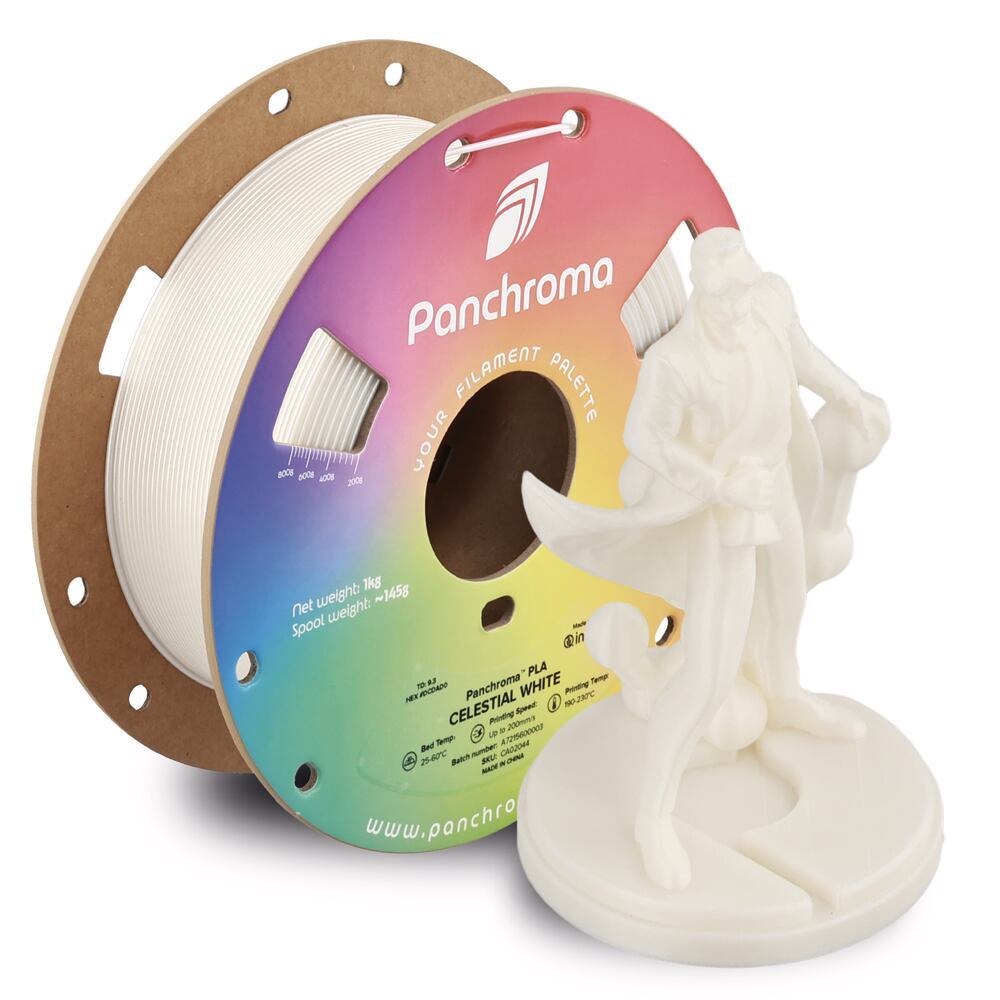
Panchroma PLA Celestial White is a PLA filament for conventional 3D printing, supplied at 1,75 mm diameter in a 1 kg pack. This Panchroma grade is specified in Celestial White, identifying the colour of the feedstock and of printed parts. The article sits in the printing materials and filaments category for conventional 3D printing. A 1 kg unit quantity gives a defined pack mass for planning, inventory and changeover on printers that accept 1,75 mm PLA. Laboratories, workshops and production environments can select it when a white PLA in this diameter and pack size is required. The filament comes from manufacturer Polymaker under the Panchroma PLA Celestial White name, combining brand, polymer type and colour on the product designation. Users of conventional 3D printers can match the 1,75 mm format to equipment specified for that filament diameter. The pack size is 1 kg, in line with the stated unit quantity. Panchroma PLA Celestial White therefore offers a clearly labelled PLA filament in Celestial White for 1,75 mm conventional 3D printing.
This article is part of 3D printer filaments & resins, in 3D printing & bioprinting.
Key features
- Pack size: 1 kg
- Material: PLA
- Colour: Celestial White
- Filament diameter: 1,75 mm
- Product line: Panchroma
Recently viewed
You may also like
Browse related categories
Category
Sub-category
Catalogue
Brand
Questions about Panchroma PLA Celestial White, 1,75 mm, 1 kg
What is this article?
Panchroma PLA Celestial White, 1,75 mm, 1 kg is the article on this page. Luminix Health distributes Carl Roth for laboratory use. It sits in 3D printer filaments & resins, inside 3D printing & bioprinting, in Lab instruments.
A filament or a resin is the material a printer polymerises or melts into an object. PLA, ABS, PETG and a photopolymer resin behave differently and need different temperatures or wavelengths. Diameter of the filament, 1.75 mm or 2.85 mm, has to match the extruder. A resin is not a filament.
A laboratory 3D printer builds a solid from a filament or a resin, layer by layer, when a shape is needed and a catalogue part does not exist. Bioprinting uses a bioink that contains, or will contain, living cells. The material decides the chemistry of the object and whether a cell will tolerate it. A filament that is only described as plastic is not a specification. Cell work around bioinks is discussed in the WHO biosafety topic and the papers are on PubMed.
Which category should I open next?
The category is 3D printing & bioprinting. The sub-category is 3D printer filaments & resins. The catalogue is Lab instruments.
Shelves beside this one are 3D printers, accessories & spare parts and Bioinks & bioprinting materials.
What should I check before I order?
When this page shows a safety data sheet, use that manufacturer file. Hazard text does not belong in the sales description. For a pack size, a grade or a certificate that is not on the page, send a quote request or contact the team.
How does ordering and shipping work?
Luminix Health distributes this article from the heart of Europe. Articles in stock ship within 2–5 business days. Standard delivery is free from €250 excl. VAT. Cold-chain goods and dangerous goods under ADR are never included in that free delivery. The terms are in the Shipping Policy. The full brand index is on shop by brand. Who we are is on about us.
Which other categories should I open?
The seven catalogues are Labware, Lab chemicals, Lab instruments, Lab consumables, Chromatography equipment, Lab safety equipment and Life Science & Microbiology.