


Description
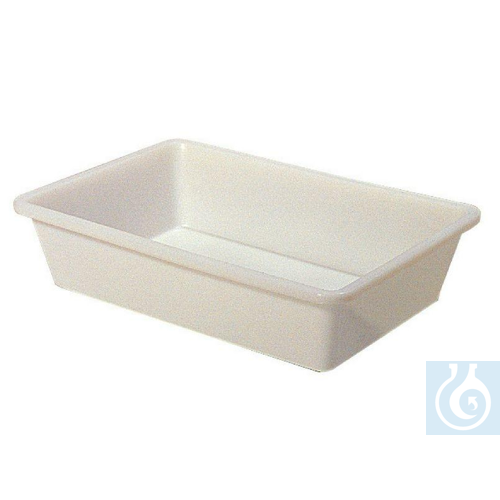
Photo trays with a nominal capacity of 6 litres provide a compact white high-density polyethylene (HDPE) bath for photographic and laboratory wet processing. Measuring 340 mm in width, 240 mm in depth and 100 mm in height, the tray offers a practical footprint for smaller sheets, test strips or limited solution volumes while remaining easy to place side by side on the bench. HDPE construction delivers a smooth interior surface that is straightforward to rinse and wipe, together with the chemical durability expected for aqueous photographic chemistry and general lab use. At a net weight of 320 g, the empty tray is light to handle yet sufficiently rigid for repeated filling and emptying. Available from manufacturer lab-o-plastix, this 6 l format suits darkroom sequences, sample immersion and temporary holding where a mid-size white plastic tray is required. Supplied as one piece, it complements larger trays in multi-stage workflows and helps keep working volumes under control without excess bench space.
This article is part of Trays, bowls & tubs, in Dishes, crucibles & porcelain.
Key features
- Pack size: 1 pc
- Nominal capacity: 6 l
- Material: High-density polyethylene (HDPE)
- Colour: White
- Dimensions (W × D × H): 340 × 240 × 100 mm
Recently viewed
You may also like
Browse related categories
Category
Sub-category
Catalogue
Brand
Questions about Photographic trays, volume 6 litre, HDPE white, dim. B 340 x D 240 x H 100 mm
What is this article?
Photographic trays, volume 6 litre, HDPE white, dim. B 340 x D 240 x H 100 mm is the article on this page. Luminix Health distributes lab-o-plastix for laboratory use. It sits in Trays, bowls & tubs, inside Dishes, crucibles & porcelain, in Labware.
A laboratory tray, bowl or tub is an open vessel for holding, staining, drying or carrying many small items at once. Polypropylene trays resist a knock and many aqueous liquids. Porcelain takes heat. The useful numbers are the bottom size and the depth, because that is the working area.
A dish is an open vessel for drying, evaporating or holding a solid. Porcelain and glazed ceramic take a higher temperature than borosilicate glass, which is why a crucible, not a beaker, goes into a furnace. A watch glass covers, or holds a small amount for drying. A mortar is for grinding. The temperature and the chemical, not the shape alone, choose the material. Laboratory ware of this family is listed under ISO laboratory ware.
Which category should I open next?
The category is Dishes, crucibles & porcelain. The sub-category is Trays, bowls & tubs. The catalogue is Labware.
Shelves beside this one are Crucibles, Mortars & pestles, Watch glasses & crystallising dishes, Evaporating dishes and Dishes (other).
What should I check before I order?
When this page shows a safety data sheet, use that manufacturer file. Hazard text does not belong in the sales description. For a pack size, a grade or a certificate that is not on the page, send a quote request or contact the team.
How does ordering and shipping work?
Luminix Health distributes this article from the heart of Europe. Articles in stock ship within 2–5 business days. Standard delivery is free from €250 excl. VAT. Cold-chain goods and dangerous goods under ADR are never included in that free delivery. The terms are in the Shipping Policy. The full brand index is on shop by brand. Who we are is on about us.
Which other categories should I open?
The seven catalogues are Labware, Lab chemicals, Lab instruments, Lab consumables, Chromatography equipment, Lab safety equipment and Life Science & Microbiology.