



Description
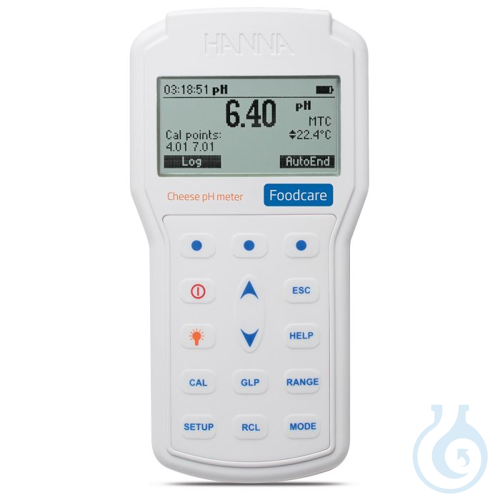
The professional cheese handheld pH/°C meter with pH electrode FC2423 is a robust, waterproof, HACCP-compliant instrument for measuring pH and temperature throughout cheese making. pH is decisive from incoming milk checks through acidification, renneting, whey drainage, brining and ripening. Starter cultures convert lactose to lactic acid and lower pH before rennet is added; whey pH at draining affects calcium and phosphate retention and curd strength, with typical separation ranges such as about pH 6,3–6,5 for Swiss-style cheese and pH 6,0–6,2 for Cheddar. Brine pH should match the cheese to maintain ion balance, while ripening pH shapes texture—higher values favour elasticity, lower values increase brittleness—and supports characteristic microbial and enzymatic development.
This article is part of pH electrodes & sensors, in pH & electrochemistry.
Cheese solids readily foul glass membranes and junctions. The Foodcare electrode FC2423 addresses this with a conical glass tip, a slim stainless steel shaft only 5 mm in diameter for low-impact piercing, and an open junction that resists clogging. Connection uses a waterproof Quick Connect DIN link. Hanna Instruments equips the meter with CAL Check™ to warn of contamination, cleaning needs or suspect buffers and to report electrode condition in 10 % steps. Supplied as 1 pc and battery powered for handheld plant and laboratory use.
Key features
- Pack size: 1 pc
- Electrode: FC2423 Foodcare with 5 mm stainless steel shaft
- Measurement: pH and temperature in cheese
- Instrument type: Handheld, waterproof, HACCP-compliant
- Power supply: Battery
Recently viewed
You may also like
Browse related categories
Category
Sub-category
Catalogue
Brand
Questions about Professional Portable Cheese pH Meter
What is this article?
Professional Portable Cheese pH Meter is the article on this page. Luminix Health distributes Hanna Instruments for laboratory use. It sits in pH electrodes & sensors, inside pH & electrochemistry, in Lab instruments.
A pH electrode is a glass membrane and a reference. It is a consumable: the glass ages, the junction clogs, and the reading drifts. A refillable electrode and a gel electrode differ in how they are maintained. The connector has to match the meter. The electrode, not the meter, is usually what is wrong.
A pH meter is a voltmeter on a glass electrode. The voltage tracks hydrogen-ion activity, and the electrode is converted to pH only after it is adjusted with buffers of known value. Conductivity measures how well a solution carries a current, which for dilute salts tracks concentration. Dissolved oxygen and titration are further electrodes on the same idea: a sensor, a standard, and a reading that is only as fresh as the calibration. Buffer values and chemical identity sit on PubChem. Accreditation of the calibration laboratory is the field of BELAC and EURAMET.
Which category should I open next?
The category is pH & electrochemistry. The sub-category is pH electrodes & sensors. The catalogue is Lab instruments.
Shelves beside this one are pH meters, Conductivity meters & cells, Dissolved oxygen & multiparameter meters, Titrators & electrochemistry systems and pH & electrochemistry accessories.
What should I check before I order?
When this page shows a safety data sheet, use that manufacturer file. Hazard text does not belong in the sales description. For a pack size, a grade or a certificate that is not on the page, send a quote request or contact the team.
How does ordering and shipping work?
Luminix Health distributes this article from the heart of Europe. Articles in stock ship within 2–5 business days. Standard delivery is free from €250 excl. VAT. Cold-chain goods and dangerous goods under ADR are never included in that free delivery. The terms are in the Shipping Policy. The full brand index is on shop by brand. Who we are is on about us.
Which other categories should I open?
The seven catalogues are Labware, Lab chemicals, Lab instruments, Lab consumables, Chromatography equipment, Lab safety equipment and Life Science & Microbiology.