
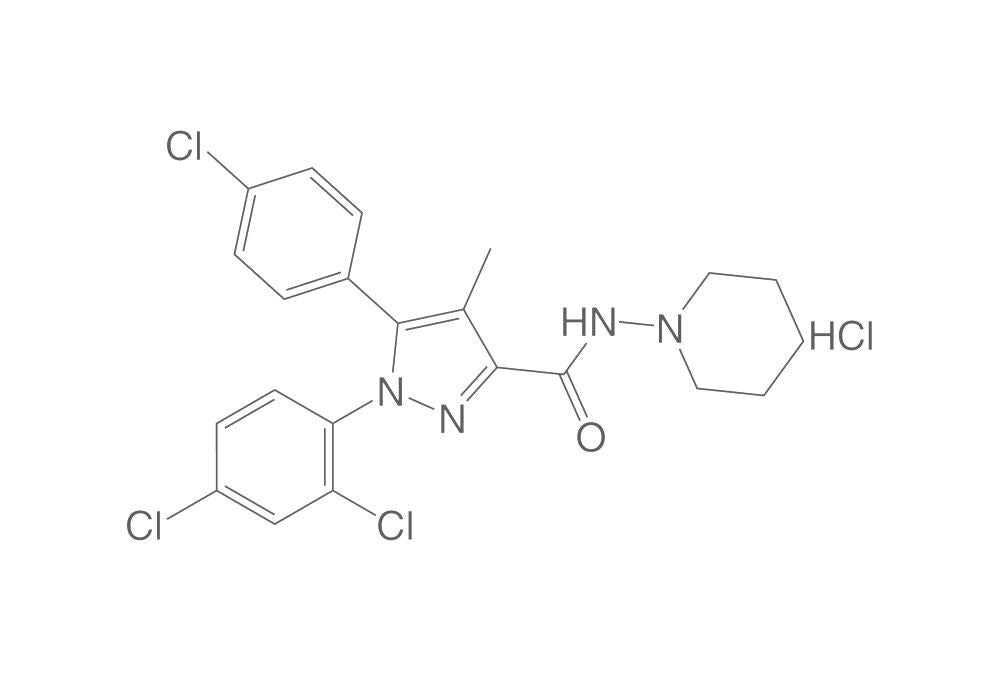


Description
Rimonabant hydrochloride is a research biochemical with CAS number 158681-13-1 and the empirical formula C₂₂H₂₂Cl₄N₄O. It has a molar mass of 500,25 g/mol. This hydrochloride salt supports biochemical and pharmaceutical research workflows that require a clearly defined molecular identity and documented composition. Supplied from manufacturer Carl ROTH, the material fits chemicals and biochemicals applications where CAS-traceable solids are preferred for stock preparation, reference work, or small-scale experimental studies. quantity provides a practical amount for method development, screening assays, and analytical investigations without excess inventory. Clear labelling of CAS number, empirical formula and molar mass aids solution calculation, batch documentation and inventory control in quality-conscious laboratories. Researchers can integrate the compound into established organic and medicinal chemistry protocols while relying on the stated molecular data for reproducible weighing and formulation. The product is intended for professional scientific use in controlled laboratory environments.
This article is part of Inorganic salts, in Inorganic chemicals.
Key features
- Purity (HPLC): ≥ 98 %
- Melting point: 230 to 242 °C
- Colour: white to off-white
- Form: powder
- ¹H-NMR Spectrum: corresponds to assigned structure
- CAS number: 158681-13-1
- Pack sizes: 250 mg, 500 mg, 1 g, 2 g
- Empirical formula: C₂₂H₂₂Cl₄N₄O
- Molar mass: 500,25 g/mol
- Storage temperature: +2 to +8 °C
- UN nr.: 2811
- Technical Information Sheet:

- Safety Data Sheet:
Compliance & Safety Information
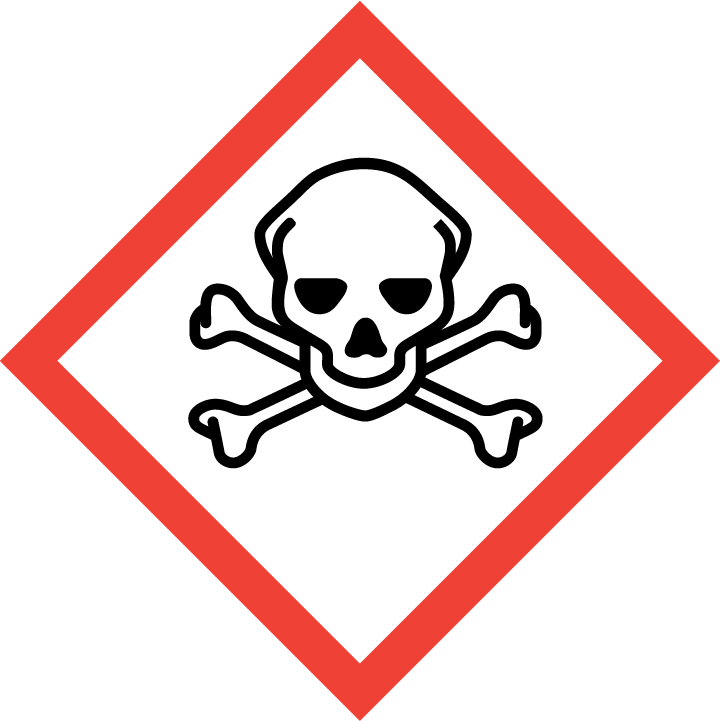 Danger
Hazard Statements (H-Phrases)
Recently viewed
You may also like
Browse related categories
Category
Organic chemicals & synthesis reagents
Sub-category
Organic building blocks & synthesis reagents
Catalogue
Brand
Questions about Rimonabant hydrochloride, 250 mg
What is this article?
Rimonabant hydrochloride, 250 mg is the article on this page. Luminix Health distributes Carl Roth for laboratory use. It sits in Organic building blocks & synthesis reagents, inside Organic chemicals & synthesis reagents, in Lab chemicals.
A building block is an organic molecule bought to become part of a larger one. The structure, the CAS number and the purity decide it. A 95 percent reagent and a 99.9 percent reagent of the same name leave different impurities in the product. The functional groups are the reason it was chosen.
An organic chemical is built on carbon. In this category it is a building block or a reagent for making another molecule: a starting material, a coupling agent, a polymer, a PEG. Purity is a specification of which impurities remain. The structure, the CAS number and the grade decide whether two bottles are the same substance. Structures and properties are on PubChem. Nomenclature is IUPAC. Classification follows ECHA and the CLP Regulation.
Which category should I open next?
The category is Organic chemicals & synthesis reagents. The sub-category is Organic building blocks & synthesis reagents. The catalogue is Lab chemicals.
Shelves beside this one are Polymers, PEGs & silicones and Click chemistry, bioconjugation & synthesis reagents.
What should I check before I order?
When this page shows a safety data sheet, use that manufacturer file. Hazard text does not belong in the sales description. For a pack size, a grade or a certificate that is not on the page, send a quote request or contact the team.
How does ordering and shipping work?
Luminix Health distributes this article from the heart of Europe. Articles in stock ship within 2–5 business days. Standard delivery is free from €250 excl. VAT. Cold-chain goods and dangerous goods under ADR are never included in that free delivery. The terms are in the Shipping Policy. The full brand index is on shop by brand. Who we are is on about us.
Which other categories should I open?
The seven catalogues are Labware, Lab chemicals, Lab instruments, Lab consumables, Chromatography equipment, Lab safety equipment and Life Science & Microbiology.