


Description
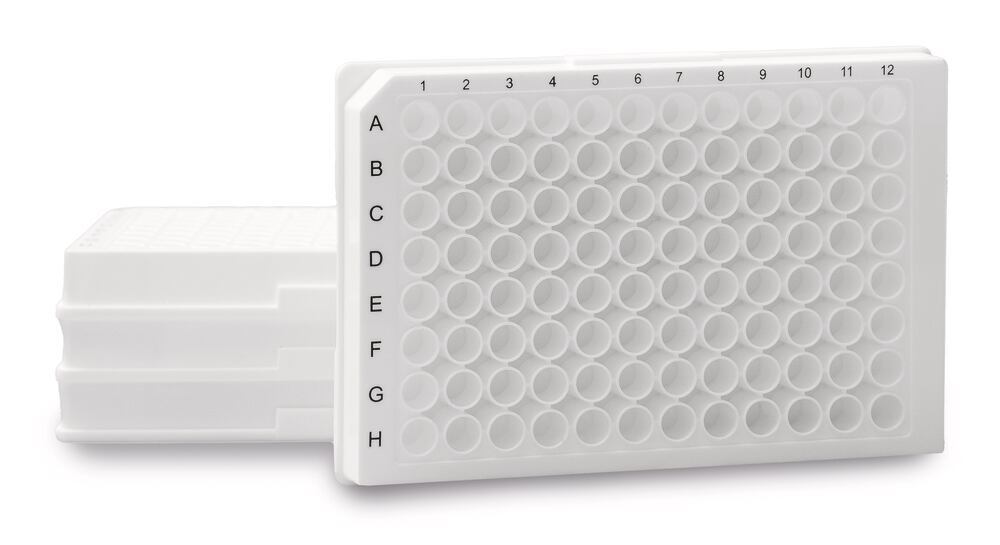
Rotilabo® microtest plates BioBased, 96-well, flat bottom, white
Environmentally-friendly alternative to polystyrene microtiter plates.
- Untreated surface for a wide range of applications
- Manufactured according to ANSI/SLAS 1-2004 to ANSI/SLAS 4-2004
- Grooved side surfaces, suitable for pipetting robots
- Temperature stability: -80 to 40 °C
- Centrifugability in g: 4,000
Chemical resistance: acetonitrile (up to 30%) / butanol / DMSO (up to 10%) / acetic acid (up to 10%) / ethanol / formaldehyde / H2O2 / HCl / methanol (up to 70%) / lactic acid / NaOH, not resistant to: acetone / chloroform. Transparent plates with optimal light transmission, UV-permeable. Suitable for photometric applications, microscopy and for determining nucleic acid and protein concentrations. Endotoxin-free and non-cytotoxic acc. to ISO 10993.
50% reduction of CO2 emissions through the use of >98% plant-based PLA. Recyclable.
| Wells | 96 |
| Volume per well | 50-200 µl |
| Colour | white |
| Sterility | Non-sterile |
| L x W x H | 127.76 x 85.18 x 14.35 mm |
| Pack. | 1 x 25 |
| ROTH for Future | yes |
Recently viewed
You may also like
Questions about Rotilabo® microtest plates BioBased, 96-well, flat bottom, white, 25 unit(s)
What is this article?
Rotilabo® microtest plates BioBased, 96-well, flat bottom, white, 25 unit(s) is the article on this page. Luminix Health distributes Carl Roth for laboratory use. It sits in Microplates, inside Microplates, PCR & reaction tubes, in Lab consumables.
A microplate is an array of wells, commonly 96 or 384, in clear, black or white plastic. Clear is for absorbance. Black is for fluorescence. The well shape, flat or round bottom, and whether the plate is sterile and treated for cells, are the specification. Not every 96-well plate fits every reader.
A microplate is an array of wells so the same step can be done many times. A deep-well plate holds more volume. A PCR plate or a strip of tubes is thin-walled so the temperature of a cycler reaches the liquid quickly. A seal keeps the well from evaporating. The well number, the working volume and whether the plate is skirted for a robot are the choices. Diagnostic test systems are listed under ISO in vitro diagnostic systems. Methods are on PubMed.
Which category should I open next?
The category is Microplates, PCR & reaction tubes. The sub-category is Microplates. The catalogue is Lab consumables.
Shelves beside this one are Microcentrifuge & reaction tubes, PCR plates, tubes & strips, Plate seals & sealing films and Deep-well plates.
What should I check before I order?
The technical information on this page is the manufacturer's sheet. Read that, not a rewritten specification.
When this page shows a safety data sheet, use that manufacturer file. Hazard text does not belong in the sales description. For a pack size, a grade or a certificate that is not on the page, send a quote request or contact the team.
How does ordering and shipping work?
Luminix Health distributes this article from the heart of Europe. Articles in stock ship within 2–5 business days. Standard delivery is free from €250 excl. VAT. Cold-chain goods and dangerous goods under ADR are never included in that free delivery. The terms are in the Shipping Policy. The full brand index is on shop by brand. Who we are is on about us.
Which other categories should I open?
The seven catalogues are Labware, Lab chemicals, Lab instruments, Lab consumables, Chromatography equipment, Lab safety equipment and Life Science & Microbiology.