



Description
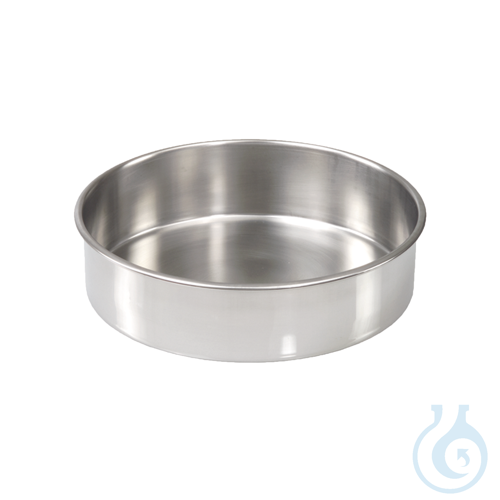
Sieve pan, 203x50 mm is a laboratory collection pan designed to form the bottom element of a sieve stack for particle-size analysis. With a diameter of 203 mm and a height of 50 mm it offers a larger receiving volume than shallower pans while remaining fully compatible with standard 203 mm sieve frames. Net weight is 0,5 kg and the unit is supplied as 1 pc(s). During dry sieving the pan gathers all material that passes the finest sieve, allowing accurate recovery and subsequent gravimetric evaluation of the undersize fraction. It is well suited to quality-control and research laboratories performing routine fractionation of powders and granular solids. Manufactured by NEXOPART in Germany, the pan integrates cleanly into multi-deck sieve assemblies without adding excessive height. The 50 mm depth accommodates moderate sample quantities while preserving stack stability on mechanical sieve shakers. Straightforward cleaning between successive analyses supports efficient laboratory throughput. This accessory completes a functional sieving set and ensures quantitative collection of fine particles in chemical, pharmaceutical and materials-testing environments.
This article is part of Test sieves (wire mesh), in Test sieves & mills.
Key features
- Pack size: 1 pc(s)
- Product type: Sieve pan
- Diameter: 203 mm
- Height: 50 mm
- Country of origin: Germany
- Technical Information Sheet:

Recently viewed
You may also like
Browse related categories
Category
Sub-category
Catalogue
Brand
Questions about Sieve pan, 203x50 mm
What is this article?
Sieve pan, 203x50 mm is the article on this page. Luminix Health distributes NEXOPART for laboratory use. It sits in Test sieves (wire mesh), inside Test sieves & mills, in Lab instruments.
A wire-mesh test sieve sorts particles through a woven opening of a stated nominal size. The frame diameter and the mesh are the specification. A sieve without a certificate is a screen, not a measurement.
A test sieve sorts particles by whether they pass an opening. Wire mesh and perforated plate are two ways of making that opening, and the nominal size is not a suggestion. A sieve shaker repeats the motion so the result does not depend on how hard someone shook by hand. A mill or grinder makes the particles smaller before they are sieved. The certificate of the sieve, and the opening size, are what an audit asks for. Measurement practice around mass and dimension sits with the BIPM, EURAMET and BELAC.
Which category should I open next?
The category is Test sieves & mills. The sub-category is Test sieves (wire mesh). The catalogue is Lab instruments.
Shelves beside this one are Test sieves (perforated plate), Mills, grinders & homogenisers, Sieve shakers and Sieve accessories (lids, pans, rings).
What should I check before I order?
When this page shows a safety data sheet, use that manufacturer file. Hazard text does not belong in the sales description. For a pack size, a grade or a certificate that is not on the page, send a quote request or contact the team.
How does ordering and shipping work?
Luminix Health distributes this article from the heart of Europe. Articles in stock ship within 2–5 business days. Standard delivery is free from €250 excl. VAT. Cold-chain goods and dangerous goods under ADR are never included in that free delivery. The terms are in the Shipping Policy. The full brand index is on shop by brand. Who we are is on about us.
Which other categories should I open?
The seven catalogues are Labware, Lab chemicals, Lab instruments, Lab consumables, Chromatography equipment, Lab safety equipment and Life Science & Microbiology.