



Description
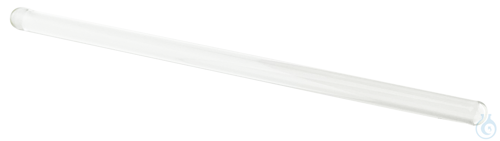
Glass stirring rods, fused at both ends 250 x 7 mm serve as versatile manual tools for blending solutions, suspensions and reaction mixtures in laboratory environments. With a length of 250 mm and a diameter of 7 mm, the rods are produced from glass and finished with fused ends on both sides, creating rounded tips that enhance user safety, prevent vessel damage and minimise contamination risks during stirring operations. This robust yet simple design allows effective agitation inside beakers, flasks, bottles and other standard containers used in analytical chemistry, life-science research and educational settings. Supplied as one piece, the stirring rod from manufacturer Hecht offers dependable mechanical strength for everyday mixing tasks while remaining easy to clean and store. Laboratories appreciate the balance of rigidity and smoothness that supports precise control when dissolving solids, dispersing powders or equalising temperature gradients in liquid samples. The unadorned glass construction ensures broad chemical compatibility for general-purpose applications where powered stirrers are unnecessary or impractical, making these rods a staple accessory on any well-equipped bench.
This article is part of Stirring rods, spreaders & glass tools, in Tools & accessories.
Key features
- Pack size: 1 pc
- Material: Glass (unspecified)
- Length: 250 mm
- Diameter: 7 mm
- Design: Fused at both ends
- Product type: Glass stirring rod
Recently viewed
You may also like
Browse related categories
Category
Sub-category
Stirring rods, spreaders & glass tools
Catalogue
Brand
Questions about Stirring rods of glass, fused ends 250 x 7 mm
What is this article?
Stirring rods of glass, fused ends 250 x 7 mm is the article on this page. Luminix Health distributes Hecht for laboratory use. It sits in Stirring rods, spreaders & glass tools, inside Tools & accessories, in Labware.
A stirring rod is the manual way to mix a beaker. A spreader is the tool that draws a culture across an agar surface. Glass is easy to clean and easy to break. The shape of the tip is the whole specification.
The small tools of the bench are what the hand actually holds: a spatula for a powder, forceps for an object that must stay clean, a brush for a narrow neck, a desiccator when a dried sample must not take up water again. None of these reads a measurement. They keep the measurement possible. The apparatus around them is listed under ISO laboratory apparatus.
Which category should I open next?
The category is Tools & accessories. The sub-category is Stirring rods, spreaders & glass tools. The catalogue is Labware.
Shelves beside this one are Spatulas & spoons, Other lab tools & accessories, Lab furniture, trolleys & storage, Tweezers & forceps, Scissors, scalpels & dissecting instruments, Weighing boats, dishes & paper, Desiccators & desiccant, Grease, boiling stones & sealants, Timers, stopwatches & calculators, Stationery, books & lab notebooks, Brushes & cleaning tools, Cutting & sealing tools and Gas handling & burners accessories.
What should I check before I order?
When this page shows a safety data sheet, use that manufacturer file. Hazard text does not belong in the sales description. For a pack size, a grade or a certificate that is not on the page, send a quote request or contact the team.
How does ordering and shipping work?
Luminix Health distributes this article from the heart of Europe. Articles in stock ship within 2–5 business days. Standard delivery is free from €250 excl. VAT. Cold-chain goods and dangerous goods under ADR are never included in that free delivery. The terms are in the Shipping Policy. The full brand index is on shop by brand. Who we are is on about us.
Which other categories should I open?
The seven catalogues are Labware, Lab chemicals, Lab instruments, Lab consumables, Chromatography equipment, Lab safety equipment and Life Science & Microbiology.