
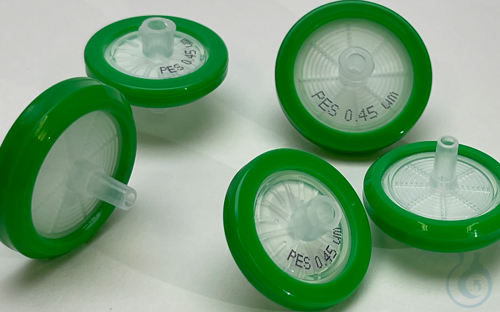


Description
Polyethersulfone (PES) syringe filters with a 0,2 µm pore size and 30 mm diameter are non-sterile laboratory membrane filters for syringe-based sample preparation. They support clarification of liquids and removal of particulates prior to analysis or further laboratory processing. The membrane is polyethersulfone (PES), combined here with the defined pore size and 30 mm diameter format. Non-sterile supply makes them suitable where sterile filtration is not specified. Pack size is 100 pieces for ongoing use in research, analytical and quality-control laboratories. Compared with smaller housings, the 30 mm diameter offers a larger filtration area for syringe-compatible sample volumes, while the 0,2 µm pore size addresses fine clarification requirements set by the working method. This variant is available from manufacturer Hahnemühle as part of the polyethersulfone syringe-filter series. Pore size and diameter should be chosen to match sample characteristics and protocol needs. The filters are intended for general laboratory filtration of compatible media when applied in line with standard laboratory practice.
This article is part of Syringe filters, in Filtration.
Key features
- Pack size: 100 pc(s)
- Storage temperature: 15-30 °C
- Membrane material: Polyethersulfone (PES)
- Pore size: 0,2 µm
- Diameter: 30 mm
- EAN: 4011367119997
Recently viewed
You may also like
Browse related categories
Category
Sub-category
Catalogue
Brand
Questions about Syringe filter, Polyethersulfone ,0.2 µm, non-sterile ,30 mm
What is this article?
Syringe filter, Polyethersulfone ,0.2 µm, non-sterile ,30 mm is the article on this page. Luminix Health distributes Hahnemühle for laboratory use. It sits in Syringe filters, inside Filtration, in Lab consumables.
A syringe filter is a membrane in a plastic housing on a Luer fitting. Pore size, membrane polymer and diameter are the three choices. 0.2 µm is the sterilising and the HPLC-particle cut. 0.45 µm is the coarser clarification. Aqueous and solvent-resistant membranes are different polymers.
Filtration holds back what is larger than the pores and lets the rest through. Paper is the ordinary laboratory filter. A membrane has a stated pore size and a polymer that must survive the solvent. A syringe filter is that membrane in a housing on a syringe. Glass fibre takes a higher dirt load. Ultrafiltration holds back macromolecules and passes salts. The pore size, the chemical compatibility and the volume are the three choices. Laboratory apparatus around filtration is indexed under ISO laboratory apparatus.
Which category should I open next?
The category is Filtration. The sub-category is Syringe filters. The catalogue is Lab consumables.
Shelves beside this one are Filter paper, Sintered glass filter plates & discs, Filter cartridges & capsules, Membrane filters, Glass & quartz fibre filters, Bottle-top & vacuum filtration units, Ultrafiltration & concentrators, Filtration accessories, Extraction thimbles and Dialysis tubing & devices.
What should I check before I order?
When this page shows a safety data sheet, use that manufacturer file. Hazard text does not belong in the sales description. For a pack size, a grade or a certificate that is not on the page, send a quote request or contact the team.
How does ordering and shipping work?
Luminix Health distributes this article from the heart of Europe. Articles in stock ship within 2–5 business days. Standard delivery is free from €250 excl. VAT. Cold-chain goods and dangerous goods under ADR are never included in that free delivery. The terms are in the Shipping Policy. The full brand index is on shop by brand. Who we are is on about us.
Which other categories should I open?
The seven catalogues are Labware, Lab chemicals, Lab instruments, Lab consumables, Chromatography equipment, Lab safety equipment and Life Science & Microbiology.