
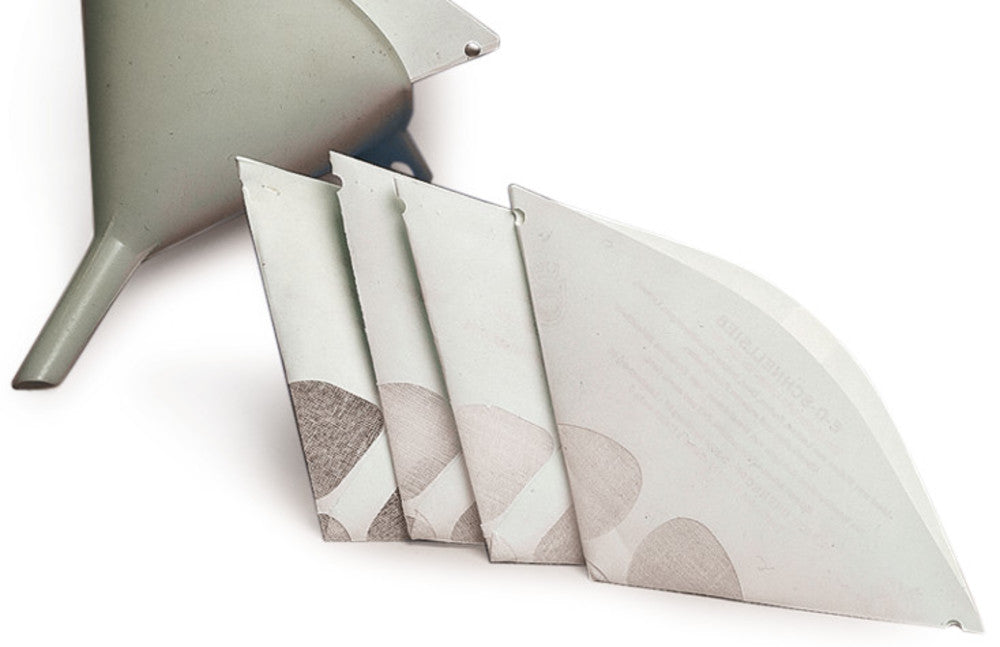


Description
Disposable filters made of nylon are laboratory filtration aids with a mesh width of 260 µm in a medium grade. Intended for separation and filtration workflows, they provide a defined nylon mesh for retaining coarser particles during sample handling, pre-filtration, or general laboratory clean-up steps. The medium mesh specification supports applications where a 260 µm opening is appropriate for the solids load and flow requirements of the process. Packed as 125 pieces with a total weight of 0,175 kg, the set suits laboratories that need a ready stock of single-use nylon filters for repeated daily work. These disposable nylon filters from manufacturer ROTH SELECTION fit within filtration and separation accessory ranges used alongside funnels, holders, and related labware. Nylon construction is widely chosen for mesh filters in chemistry, life-science, and materials laboratories when a synthetic polymer mesh at the stated width is required. Clear indication of mesh width and medium grade simplifies matching to existing protocols and inventory lists. The multi-piece pack supports efficient replenishment without over-specifying performance beyond the mesh data provided. Use them wherever disposable nylon mesh filters at 260 µm are specified for routine laboratory filtration tasks.
This article is part of Membrane filters, in Filtration.
Key features
- Pack size: 125 pc(s)
- Product type: Disposable nylon filters
- Material: Nylon
- Mesh width: 260 µm
- Grade: Medium
- Weight: 0,175 kg
Recently viewed
You may also like
Browse related categories
Category
Sub-category
Catalogue
Brand
Questions about Disposable filters made of Nylon, mesh width 260 µm, medium, 125 unit(s)
What is this article?
Disposable filters made of Nylon, mesh width 260 µm, medium, 125 unit(s) is the article on this page. Luminix Health distributes Carl Roth for laboratory use. It sits in Membrane filters, inside Filtration, in Lab consumables.
A membrane filter is the disc itself, without a syringe housing. Pore size, polymer and diameter are the specification, and the disc has to sit in a holder. Gridded membranes are for counting colonies. A membrane and a filter paper of the same diameter are not interchangeable.
Filtration holds back what is larger than the pores and lets the rest through. Paper is the ordinary laboratory filter. A membrane has a stated pore size and a polymer that must survive the solvent. A syringe filter is that membrane in a housing on a syringe. Glass fibre takes a higher dirt load. Ultrafiltration holds back macromolecules and passes salts. The pore size, the chemical compatibility and the volume are the three choices. Laboratory apparatus around filtration is indexed under ISO laboratory apparatus.
Which category should I open next?
The category is Filtration. The sub-category is Membrane filters. The catalogue is Lab consumables.
Shelves beside this one are Filter paper, Sintered glass filter plates & discs, Syringe filters, Filter cartridges & capsules, Glass & quartz fibre filters, Bottle-top & vacuum filtration units, Ultrafiltration & concentrators, Filtration accessories, Extraction thimbles and Dialysis tubing & devices.
What should I check before I order?
The technical information on this page is the manufacturer's sheet. Read that, not a rewritten specification.
When this page shows a safety data sheet, use that manufacturer file. Hazard text does not belong in the sales description. For a pack size, a grade or a certificate that is not on the page, send a quote request or contact the team.
How does ordering and shipping work?
Luminix Health distributes this article from the heart of Europe. Articles in stock ship within 2–5 business days. Standard delivery is free from €250 excl. VAT. Cold-chain goods and dangerous goods under ADR are never included in that free delivery. The terms are in the Shipping Policy. The full brand index is on shop by brand. Who we are is on about us.
Which other categories should I open?
The seven catalogues are Labware, Lab chemicals, Lab instruments, Lab consumables, Chromatography equipment, Lab safety equipment and Life Science & Microbiology.