


Description
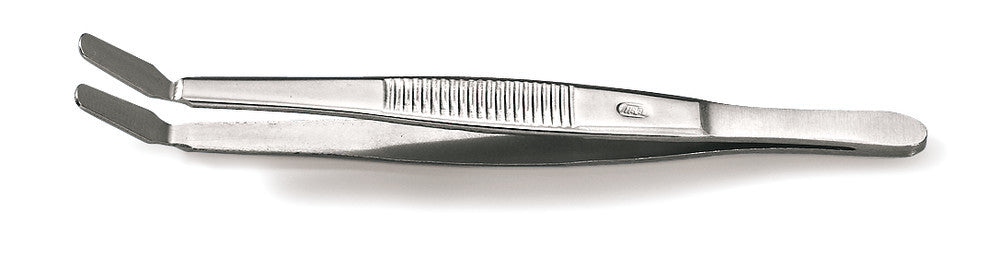
Forceps for handling cover slips, curved according to Kühne, are precision instruments intended for controlled handling of glass cover slips in microscopy and histology laboratories. Fabricated from steel 18/9, the curved tips provide a reliable hold when lifting, aligning or removing cover slips during slide preparation and related workflows. At 130 mm overall length, the forceps offer a balanced reach that suits both close microscope work and general bench handling. The single-piece pack weighs 0,021 kg and comes from manufacturer ROTH SELECTION for everyday use in life-science, pathology and materials microscopy. The Kühne curved profile is chosen to improve tip access and reduce the chance of slipping on smooth glass surfaces, helping protect thin optical specimens. Steel 18/9 construction contributes to mechanical stability and ease of cleaning between tasks. These special tweezers are a practical alternative to standard forceps whenever cover-slip placement demands fine control without contaminating the optical surface, supporting consistent sample preparation in research and routine laboratory environments.
This article is part of Microscope slides & cover glasses, in Microscopy & histology.
Key features
- Pack size: 1 pc
- Product type: Forceps for cover slip handling
- Design: Curved, according to Kühne
- Material: Steel 18/9
- Length: 130 mm
- Weight: 0,021 kg
Recently viewed
You may also like
Questions about Forceps for handling cover slip, curved, according to Kühne, steel 18/9, L 130 mm
What is this article?
Forceps for handling cover slip, curved, according to Kühne, steel 18/9, L 130 mm is the article on this page. Luminix Health distributes Carl Roth for laboratory use. It sits in Microscope slides & cover glasses, inside Microscopy & histology, in Lab instruments.
A slide is the glass a specimen sits on. A cover glass is the thin sheet over it, of a thickness the objective was designed for. A cover glass of the wrong thickness softens the image. Charged and plain slides hold sections differently.
A light microscope forms an image with glass lenses and transmitted or reflected light. A stereo microscope is the lower-magnification instrument for dissecting and for looking at a surface. Fluorescence needs a light source and filters matched to the dye. Histology is the preparation that makes a tissue readable: fixation, a cassette, a section, a stain. The objective's magnification and numerical aperture decide the resolution. The slide and the cover glass decide whether the section sits in the focal plane. Stains and dyes as substances are identified on PubChem. Papers on the methods are on PubMed.
Which category should I open next?
The category is Microscopy & histology. The sub-category is Microscope slides & cover glasses. The catalogue is Lab instruments.
Shelves beside this one are Microscope objectives, eyepieces & optics, Histology cassettes & moulds, Counting chambers & haemocytometers, Stereo microscopes, Light & fluorescence microscopes, Histology reagents & consumables, Microscopy accessories, Cold light sources & lighting and Digital & USB microscopes.
What should I check before I order?
The technical information on this page is the manufacturer's sheet. Read that, not a rewritten specification.
When this page shows a safety data sheet, use that manufacturer file. Hazard text does not belong in the sales description. For a pack size, a grade or a certificate that is not on the page, send a quote request or contact the team.
How does ordering and shipping work?
Luminix Health distributes this article from the heart of Europe. Articles in stock ship within 2–5 business days. Standard delivery is free from €250 excl. VAT. Cold-chain goods and dangerous goods under ADR are never included in that free delivery. The terms are in the Shipping Policy. The full brand index is on shop by brand. Who we are is on about us.
Which other categories should I open?
The seven catalogues are Labware, Lab chemicals, Lab instruments, Lab consumables, Chromatography equipment, Lab safety equipment and Life Science & Microbiology.