
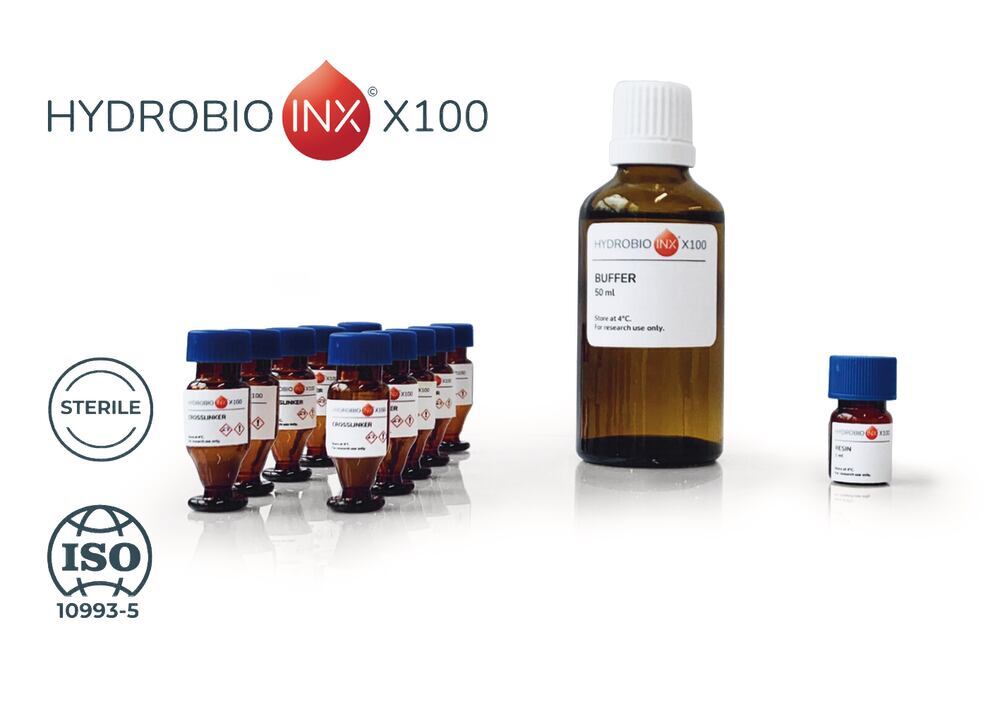


Description
HYDROBIO INX X100 is a bioink kit developed for multiphoton lithography (MPL) applications in bioprinting and hydrogel biofabrication. The formulation supports high-resolution structuring of hydrated three-dimensional architectures where multiphoton polymerisation defines fine features in soft-matter constructs. With an approximate density of 1 g/cm³, the material provides straightforward physical reference values for dosing, handling and process planning. It is delivered as a complete 1 kit unit in cardboard packaging for laboratories working on cell-compatible scaffolds, microstructured hydrogels and related MPL print jobs. The kit format streamlines preparation ahead of printing sessions and helps standardise material input across experimental series. This product comes from manufacturer BIO INX© within the multiphoton lithography bioink range. Researchers exploring hydrogel-based microstructures can integrate the ink into established MPL workflows that demand precise feature control. Approximate density near 1 g/cm³ aids volume and mass calculations during print-parameter optimisation. Academic and industrial groups focused on advanced bioprinting can use a dedicated MPL hydrogel kit for iterative design of hydrated three-dimensional research structures.
This article is part of 3D printers, accessories & spare parts, in 3D printing & bioprinting.
Key features
- Technical Information Sheet:

- Safety Data Sheet:
Compliance & Safety Information
 Warning
Hazard Statements (H-Phrases)
Precautionary Statements (P-Phrases)
Recently viewed
You may also like
Browse related categories
Category
Sub-category
3D printers, accessories & spare parts
Catalogue
Brand
Questions about HYDROBIO INX X100, Kit, for Multiphoton Lithography (MPL), 1 kit, cardboard
What is this article?
HYDROBIO INX X100, Kit, for Multiphoton Lithography (MPL), 1 kit, cardboard is the article on this page. Luminix Health distributes BIO INX© for laboratory use. It sits in 3D printers, accessories & spare parts, inside 3D printing & bioprinting, in Lab instruments.
These are the printers themselves and the nozzles, beds and build plates that wear out. Nozzle diameter decides detail against speed. A spare nozzle for a different extruder thread does not fit. The printer's build volume is the largest object it can make.
A laboratory 3D printer builds a solid from a filament or a resin, layer by layer, when a shape is needed and a catalogue part does not exist. Bioprinting uses a bioink that contains, or will contain, living cells. The material decides the chemistry of the object and whether a cell will tolerate it. A filament that is only described as plastic is not a specification. Cell work around bioinks is discussed in the WHO biosafety topic and the papers are on PubMed.
Which category should I open next?
The category is 3D printing & bioprinting. The sub-category is 3D printers, accessories & spare parts. The catalogue is Lab instruments.
Shelves beside this one are 3D printer filaments & resins and Bioinks & bioprinting materials.
What should I check before I order?
The technical information on this page is the manufacturer's sheet. Read that, not a rewritten specification.
When this page shows a safety data sheet, use that manufacturer file. Hazard text does not belong in the sales description. For a pack size, a grade or a certificate that is not on the page, send a quote request or contact the team.
How does ordering and shipping work?
Luminix Health distributes this article from the heart of Europe. Articles in stock ship within 2–5 business days. Standard delivery is free from €250 excl. VAT. Cold-chain goods and dangerous goods under ADR are never included in that free delivery. The terms are in the Shipping Policy. The full brand index is on shop by brand. Who we are is on about us.
Which other categories should I open?
The seven catalogues are Labware, Lab chemicals, Lab instruments, Lab consumables, Chromatography equipment, Lab safety equipment and Life Science & Microbiology.