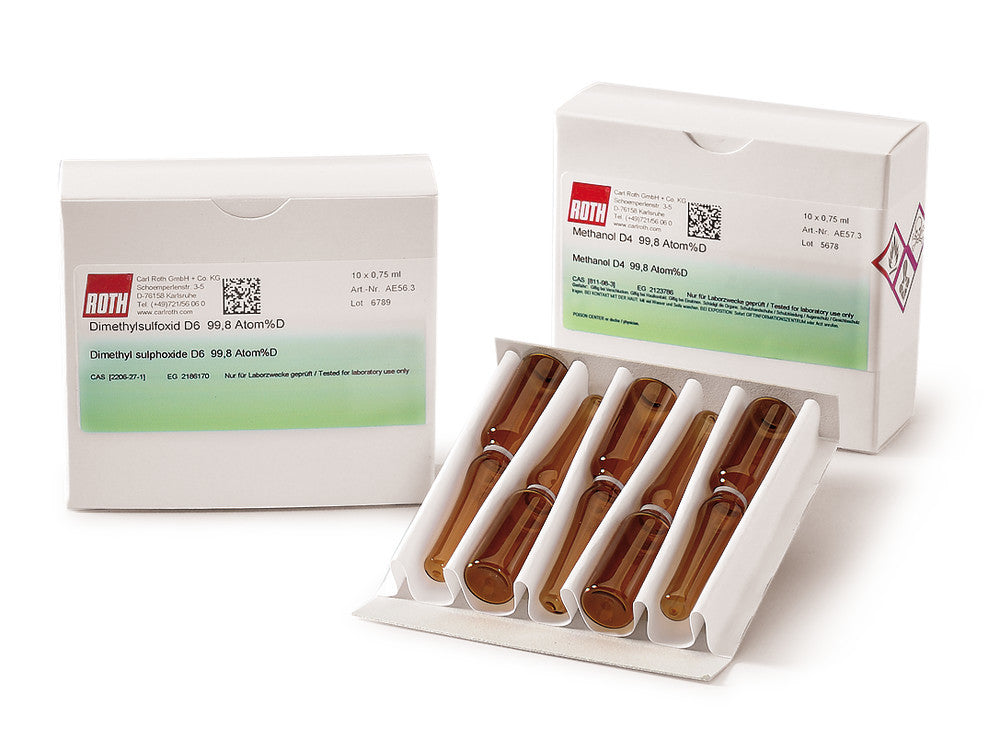


Description
Dimethyl sulphoxide D₆ with TMS (0.03 Vo) is a deuterated NMR solvent blend at 99,9 Atom%D, supplied ready for nuclear magnetic resonance measurements that benefit from an internal reference. The base solvent corresponds to CAS number 2206-27-1 and empirical formula C₂D₆OS, with molar mass 84,18 g/mol, density 1,19 g/cm³, boiling point 189 °C, flash point 88 °C and EG nr. 218-617-0. Packed as 7,5 ml in a glass ampoule, the preparation combines high deuterium enrichment with a defined TMS addition for chemical-shift referencing. Data from manufacturer Carl ROTH support use in structural elucidation, residual-signal control and routine spectrometric sample work-up. The ampoule format suits controlled dispensing in analytical laboratories. Clear specification of Atom%D, TMS content, CAS identity and thermal properties helps select this dimethyl sulphoxide D₆ grade for NMR protocols requiring both lock solvent performance and an internal standard in one convenient pack.
This article is part of Analytical grade solvents (p.a.), in Solvents.
Key features
- Deuterising degree: ≥99,9 %
- Water (KF, H2O+D2O): ≤0,025 %
- Trimethylsilane (TMS): 0,02-0,04 %
- CAS number: 2206-27-1
- Pack size: 7,5 ml glass ampoule
- EG nr.: 218-617-0
- Purity: 99,9 Atom%D
- Molar mass: 84,18 g/mol
- Density: 1,19 g/cm³
- Technical Information Sheet:

- Safety Data Sheet:
Recently viewed
You may also like
Questions about Dimethyl sulphoxide D6 with TMS (0.03 Vo, 99,9 Atom%D, 7.5 ml, glass ampoule
What is this article?
Dimethyl sulphoxide D6 with TMS (0.03 Vo, 99,9 Atom%D, 7.5 ml, glass ampoule is the article on this page. Luminix Health distributes Carl Roth for laboratory use. It sits in Analytical grade solvents (p.a.), inside Solvents, in Lab chemicals.
An analytical-grade solvent, often marked p.a., has impurity limits tight enough for classical analysis and for preparing reagents. It is not automatically low enough in UV absorbance for HPLC, and it is not dry enough for a water-sensitive reaction. The grade is the purchase.
A solvent dissolves. The grade says which impurities are low enough for the method. Analytical grade is the ordinary pure solvent. HPLC and LC-MS grades limit the absorbance and the ions that would become peaks or background. A dry solvent has had water removed. A deuterated solvent is for NMR, where the hydrogen signal would otherwise drown the sample. Technical grade is for cleaning and for synthesis that does not need a chromatogram. Identity is on PubChem. Names follow IUPAC. Hazards follow ECHA, the CLP Regulation and REACH.
Which category should I open next?
The category is Solvents. The sub-category is Analytical grade solvents (p.a.). The catalogue is Lab chemicals.
Shelves beside this one are HPLC & LC-MS grade solvents, Dry & deuterated solvents (NMR, synthesis), Technical & synthesis grade solvents and Green & alternative solvents.
What should I check before I order?
When this page shows a safety data sheet, use that manufacturer file. Hazard text does not belong in the sales description. For a pack size, a grade or a certificate that is not on the page, send a quote request or contact the team.
How does ordering and shipping work?
Luminix Health distributes this article from the heart of Europe. Delivery across Europe, two to five days when in stock. Standard delivery is free from €250 excl. VAT. Cold-chain goods and dangerous goods under ADR are never included in that free delivery. The terms are in the Shipping Policy. The full brand index is on shop by brand. Who we are is on about us.
Which other categories should I open?
The seven catalogues are Labware, Lab chemicals, Lab instruments, Lab consumables, Chromatography equipment, Lab safety equipment and Life Science & Microbiology.