


Description
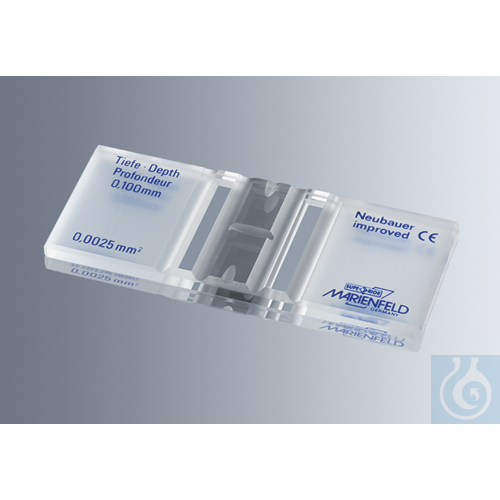
Thoma counting chambers with bright lines and V-groove are precision haemocytometers for microscopic cell and particle enumeration. Each chamber has a double network ruling and a standardised depth of 0,1 mm, ensuring defined sample volumes for reproducible counts. Two cover glasses of 0,4 mm thickness are supplied with every unit. The bright-line grid improves contrast and readability of the counting squares, while the integrated V-groove facilitates convenient sample loading. Designed without spring clips, these chambers are intended for applications in accordance with EU Regulation 2017/746 on in vitro diagnostic medical devices (IVDR). They carry the CE mark together with a batch number that supports comprehensive product information and full lot traceability. Offered by manufacturer Marienfeld in a bulk pack of 10 pieces, the Thoma new counting chambers suit routine haematology, cell-culture and research workflows where dependable microscopic enumeration is required. Clear optics and robust construction make them a practical choice for diagnostic and life-science laboratories performing frequent cell counts.
This article is part of Counting chambers & haemocytometers, in Microscopy & histology.
Key features
- Pack size: 10 pc(s)
- Chamber depth: 0,1 mm
- Cover glass thickness: 0,4 mm
- Grid type: Double network division, bright lines
- Design: With V-groove, without spring clips
- EAN: 4262367211253
Recently viewed
You may also like
Questions about Counting chambers Thoma neu with bright line, CE, with V-slash
What is this article?
Counting chambers Thoma neu with bright line, CE, with V-slash is the article on this page. Luminix Health distributes Marienfeld for laboratory use. It sits in Counting chambers & haemocytometers, inside Microscopy & histology, in Lab instruments.
A counting chamber is a slide with a ruled grid of known depth, so cells in a volume can be counted under a microscope. A haemocytometer is that chamber for blood or for cultured cells. The depth and the ruling are the specification. A scratched grid miscounts.
A light microscope forms an image with glass lenses and transmitted or reflected light. A stereo microscope is the lower-magnification instrument for dissecting and for looking at a surface. Fluorescence needs a light source and filters matched to the dye. Histology is the preparation that makes a tissue readable: fixation, a cassette, a section, a stain. The objective's magnification and numerical aperture decide the resolution. The slide and the cover glass decide whether the section sits in the focal plane. Stains and dyes as substances are identified on PubChem. Papers on the methods are on PubMed.
Which category should I open next?
The category is Microscopy & histology. The sub-category is Counting chambers & haemocytometers. The catalogue is Lab instruments.
Shelves beside this one are Microscope slides & cover glasses, Microscope objectives, eyepieces & optics, Histology cassettes & moulds, Stereo microscopes, Light & fluorescence microscopes, Histology reagents & consumables, Microscopy accessories, Cold light sources & lighting and Digital & USB microscopes.
What should I check before I order?
When this page shows a safety data sheet, use that manufacturer file. Hazard text does not belong in the sales description. For a pack size, a grade or a certificate that is not on the page, send a quote request or contact the team.
How does ordering and shipping work?
Luminix Health distributes this article from the heart of Europe. Articles in stock ship within 2–5 business days. Standard delivery is free from €250 excl. VAT. Cold-chain goods and dangerous goods under ADR are never included in that free delivery. The terms are in the Shipping Policy. The full brand index is on shop by brand. Who we are is on about us.
Which other categories should I open?
The seven catalogues are Labware, Lab chemicals, Lab instruments, Lab consumables, Chromatography equipment, Lab safety equipment and Life Science & Microbiology.