
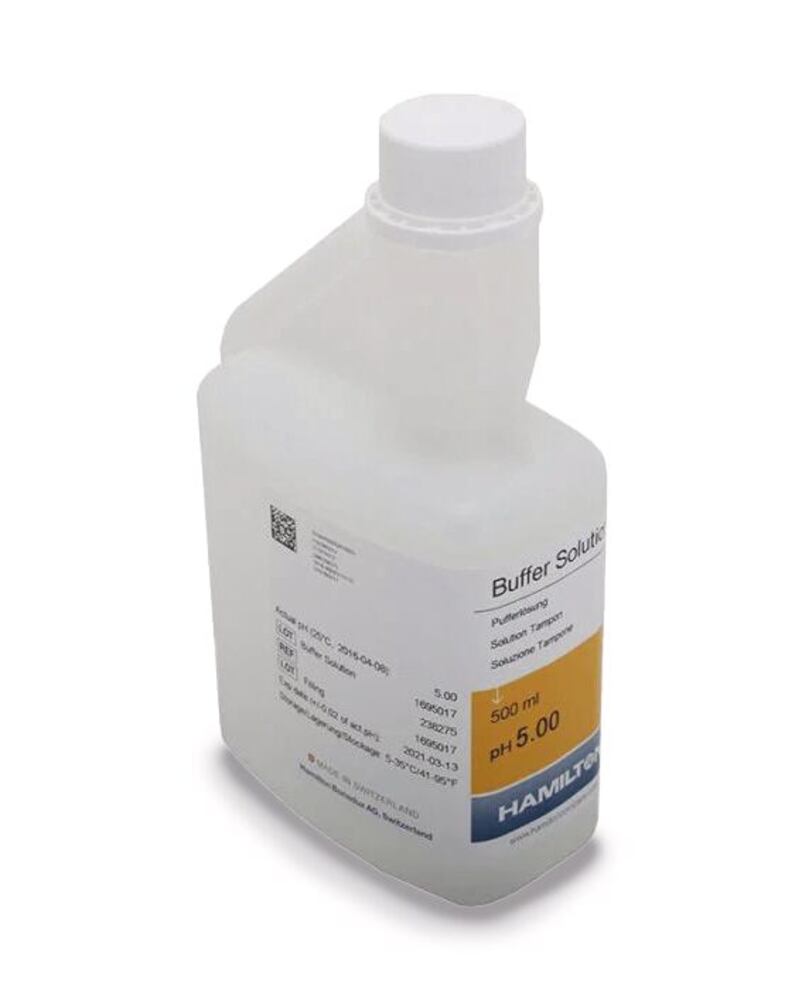


Description
La solution tampon DuraCal pH 5,00 (25 °C) est un tampon d'étalonnage incolore destiné à la détermination précise du pH et à l'étalonnage des électrodes en laboratoire. Définie à la température de référence de 25 °C, elle fournit un point de consigne stable de pH 5,00 pour les séquences d'étalonnage courantes et multipoints. Cette solution prête à l'emploi est fournie dans un conditionnement de 500 ml et présente une densité d'environ 1 g/cm³ ainsi qu'un point d'ébullition de 100 °C, conformément à un tampon aqueux dans des conditions de travail standard. Chaque unité est accompagnée d'un certificat Hamilton, garantissant une traçabilité documentée dans les environnements analytiques soumis à un contrôle qualité. Proposé par le fabricant HAMILTON au sein de la gamme DuraCal, ce tampon incolore est adapté aux applications en chimie analytique, en contrôle qualité, ainsi que dans les laboratoires de recherche et d'enseignement où des mesures fiables des propriétés physiques sont requises. Son aspect limpide facilite les contrôles visuels lors de la manipulation, tandis que son volume pratique de 500 ml permet des étalonnages répétés sans changement fréquent de flacon. Utilisez ce tampon DuraCal pH 5,00 partout où un point de référence acide bien défini est nécessaire, parallèlement à d'autres étalons de pH certifiés.
Cet article appartient à la collection Tampons pH et étalons de conductivité, dans Solutions tampons et pH.
Caractéristiques principales
- Valeur du pH (25 °C) : 5,00 ±0,02
- Conditionnement : 500 ml
- Densité : ~1 g/cm³
- Point d'ébullition : 100 °C
- Type de produit : Solution tampon pH
- Valeur du pH : 5,00 (25 °C)
- Aspect : incolore
- Fiche de données de sécurité :

Compliance & Safety Information
Hazard Statements (H-Phrases)
Récemment consulté
Vous aimerez peut-être aussi
Questions about Solution tampon DuraCal pH 5,00 (25 °C), incolore, avec certificat Hamilton
What is this article?
Solution tampon DuraCal pH 5,00 (25 °C), incolore, avec certificat Hamilton is the article on this page. Luminix Health distributes HAMILTON for laboratory use. It sits in pH buffers & conductivity standards, inside Buffers & pH solutions, in Produits chimiques.
A pH buffer for calibration has a stated pH at a stated temperature, often traceable. A conductivity standard has a stated conductivity. They are not general reagents and they should not be poured back into the bottle. The temperature of the measurement has to be the temperature on the label, or the meter has to compensate.
A buffer resists a change in pH when a little acid or base is added. It does that because a weak acid and its conjugate base are both present. A pH buffer used to calibrate a meter has a stated value at a stated temperature. A biological buffer such as Tris or HEPES is chosen because it holds the pH of a living system and does not poison it. Conductivity standards are the sister articles for a conductivity meter. The ions are on PubChem. Electrode calibration practice sits with EURAMET and BELAC.
Which category should I open next?
The category is Buffers & pH solutions. The sub-category is pH buffers & conductivity standards. The catalogue is Produits chimiques.
Shelves beside this one are Biological buffers (Tris, HEPES, MOPS) and Buffers (other).
What should I check before I order?
The technical information on this page is the manufacturer's sheet. Read that, not a rewritten specification.
When this page shows a safety data sheet, use that manufacturer file. Hazard text does not belong in the sales description. For a pack size, a grade or a certificate that is not on the page, send a quote request or contact the team.
How does ordering and shipping work?
Luminix Health distributes this article from the heart of Europe. Articles in stock ship within 2–5 business days. Standard delivery is free from €250 excl. VAT. Cold-chain goods and dangerous goods under ADR are never included in that free delivery. The terms are in the Shipping Policy. The full brand index is on shop by brand. Who we are is on about us.
Which other categories should I open?
The seven catalogues are Labware, Lab chemicals, Lab instruments, Lab consumables, Chromatography equipment, Lab safety equipment and Life Science & Microbiology.