



Description
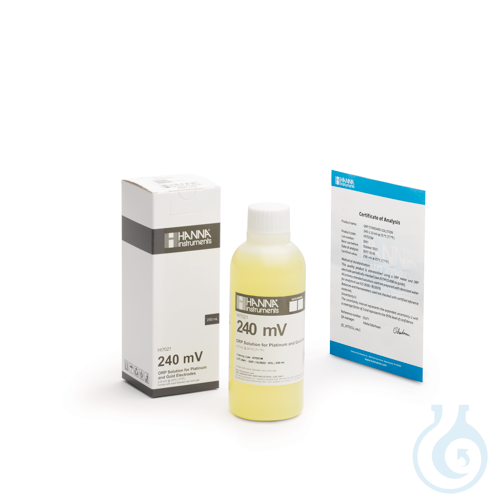
ORP test solution 240 mV is a ready-to-use test solution for functional verification of redox potential electrodes. Packed in a convenient 230 ml plastic bottle, it offers a nominal redox value of 240 mV so users can quickly assess whether an ORP electrode is responding correctly prior to measurement. The compact volume suits laboratories and service kits that perform occasional electrode checks without needing a large stock bottle. Typical applications include routine maintenance of ORP sensors in water analysis, process monitoring, and general electrochemical work where a simple go/no-go functional test is required. Net weight is 0,26 kg (gross weight 1,26 kg). This redox solution from manufacturer Hanna Instruments integrates easily into workflows alongside pH/ORP meters and combination electrodes. For best results, rinse the electrode, immerse it in a fresh aliquot of the 240 mV solution, allow the display to stabilise, and compare the reading with the stated value following the instrument manufacturer’s guidance. Do not return used solution to the bottle; keep the container closed between uses to preserve solution quality for subsequent checks.
This article belongs on Reagents for analysis (Ph. Eur., ASTM, DIN), in Analytical standards & reference materials.
Key features
- Pack size: 230 ml plastic bottle
- Product type: ORP / redox test solution
- Redox value: 240 mV
- Bottle material: Plastic
Recently viewed
You may also like
Browse related categories
Category
Analytical standards & reference materials
Sub-category
Reagents for analysis (Ph. Eur., ASTM, DIN)
Catalogue
Brand
Questions about 240 mV @25°C ORP Test Solution, 230 mL bottle
What is this article?
240 mV @25°C ORP Test Solution, 230 mL bottle is the article on this page. Luminix Health distributes Hanna Instruments for laboratory use. It sits in Reagents for analysis (Ph. Eur., ASTM, DIN), inside Analytical standards & reference materials, in Lab chemicals.
A reagent for analysis is a chemical whose impurities are limited so they do not become a signal in a titration, a digestion or a photometric method. Pharmacopoeia, ASTM and DIN names point at different limit lists. The grade, not only the identity, is the purchase.
A reference material is the article against which another result is compared. Its value is stated, and the uncertainty of that value is part of the product. An ICP or ion standard is a solution of known concentration. A volumetric standard is for titration. A chromatography standard is the peak you match. The grade names, including pharmacopoeia and ASTM, say which impurities were limited. Identity is checked on PubChem. Names follow IUPAC. Medicinal grades follow the European Pharmacopoeia and USP.
Which category should I open next?
The category is Analytical standards & reference materials. The sub-category is Reagents for analysis (Ph. Eur., ASTM, DIN). The catalogue is Lab chemicals.
Shelves beside this one are ICP, AAS & ion standards, Chromatography standards (GC, HPLC, pesticides), Reference substances & reagents (other), Volumetric standard solutions (titration), Spectroscopy & physical property standards and Indicators & indicator solutions.
What should I check before I order?
When this page shows a safety data sheet, use that manufacturer file. Hazard text does not belong in the sales description. For a pack size, a grade or a certificate that is not on the page, send a quote request or contact the team.
How does ordering and shipping work?
Luminix Health distributes this article from the heart of Europe. Articles in stock ship within 2–5 business days. Standard delivery is free from €250 excl. VAT. Cold-chain goods and dangerous goods under ADR are never included in that free delivery. The terms are in the Shipping Policy. The full brand index is on shop by brand. Who we are is on about us.
Which other categories should I open?
The seven catalogues are Labware, Lab chemicals, Lab instruments, Lab consumables, Chromatography equipment, Lab safety equipment and Life Science & Microbiology.