
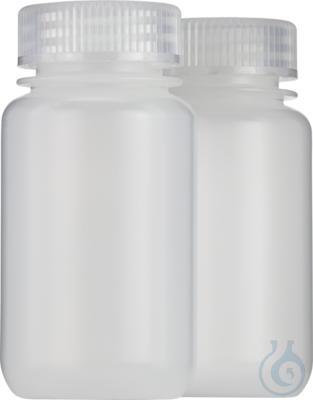



Description
Buffer PC is a binding buffer supplied in a 125 mL bottle for laboratory biochromatography applications. It is formulated for binding steps in which target molecules are retained on a suitable matrix during sample preparation, wash, or purification sequences. The compact volume suits method development, smaller sample series, and laboratories that prefer limited open-bottle exposure while maintaining a dedicated PC binding reagent on hand.
This article is part of Sorbents, silica gel & ion exchangers, in SPE & sample preparation.
This binding buffer PC comes from manufacturer Macherey-Nagel as a ready bottle pack for direct bench use. It belongs to the reagent class used in biochromatography and carries UN 1993 classification as a flammable liquid, n.o.s. (ethanol mixture), packing group III, with corresponding ADR transport provisions. GHS labelling includes GHS02 and GHS07 with the signal word Warning, covering flammable liquid and vapour as well as harmful if swallowed and skin or eye irritation; keep away from heat and ignition sources and use appropriate protective measures.
Net weight is 0,18 kg, making the 125 mL unit convenient for storage and controlled dispensing. Buffer PC supports binding stages within established chromatography or extraction workflows where a PC binding buffer is specified, helping laboratories keep reagent identity and process steps clearly aligned.
Key features
- Pack size: 125 ml
- Storage temperature: 18 - 25 °C
- Buffer type: Binding buffer PC
- Presentation: Bottle
- EAN: 4046681156236
- Technical Information Sheet:

- Safety Data Sheet:
Compliance & Safety Information
 Warning
Hazard Statements (H-Phrases)
Precautionary Statements (P-Phrases)
Recently viewed
You may also like
Browse related categories
Category
Sub-category
Sorbents, silica gel & ion exchangers
Catalogue
Brand
Questions about Buffer PC (125 mL)
What is this article?
Buffer PC (125 mL) is the article on this page. Luminix Health distributes Macherey-Nagel for laboratory use. It sits in Sorbents, silica gel & ion exchangers, inside SPE & sample preparation, in Chromatography equipment.
Loose sorbent, silica gel and ion-exchange resin are the phases bought in bulk to pack a column or to stir into a solution. Particle size and activity, or the ion-exchange capacity, are the specification. A TLC silica and a flash silica of different particle sizes are not the same separation.
Solid-phase extraction holds a compound on a sorbent while the rest of the sample is washed away, then releases it in a small volume. The sorbent, the bed mass and the solvents are the method. Silica, ion exchangers and polymer phases do different jobs. A flash column is the same idea scaled toward purification rather than trace cleanup. The molecules are on PubChem, named by IUPAC.
Which category should I open next?
The category is SPE & sample preparation. The sub-category is Sorbents, silica gel & ion exchangers. The catalogue is Chromatography equipment.
Shelves beside this one are SPE cartridges & columns and Flash, empty & glass chromatography columns.
What should I check before I order?
When this page shows a safety data sheet, use that manufacturer file. Hazard text does not belong in the sales description. For a pack size, a grade or a certificate that is not on the page, send a quote request or contact the team.
How does ordering and shipping work?
Luminix Health distributes this article from the heart of Europe. Articles in stock ship within 2–5 business days. Standard delivery is free from €250 excl. VAT. Cold-chain goods and dangerous goods under ADR are never included in that free delivery. The terms are in the Shipping Policy. The full brand index is on shop by brand. Who we are is on about us.
Which other categories should I open?
The seven catalogues are Labware, Lab chemicals, Lab instruments, Lab consumables, Chromatography equipment, Lab safety equipment and Life Science & Microbiology.