



Description
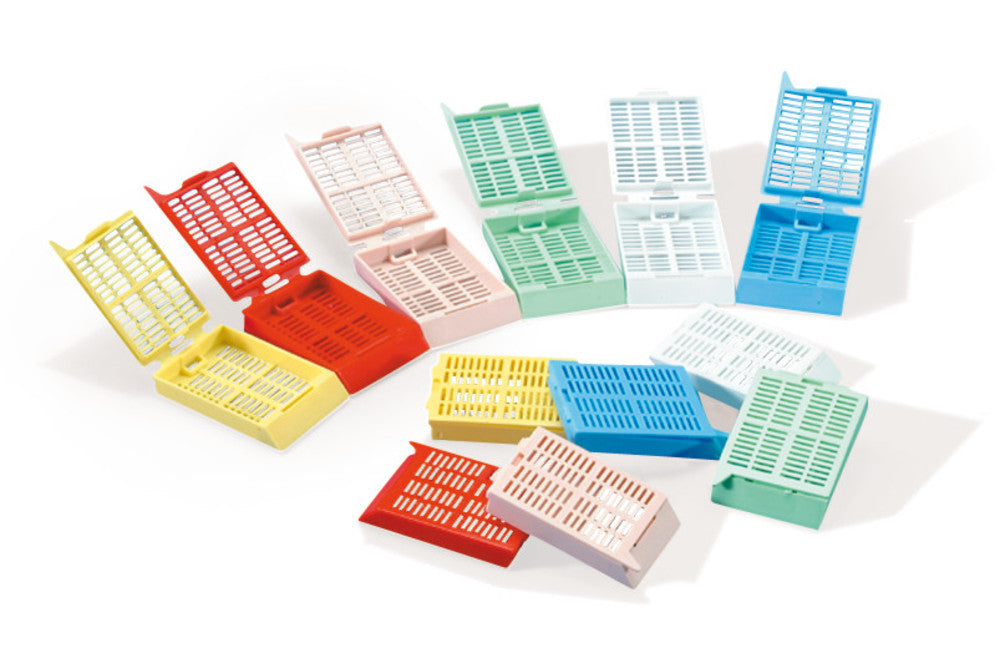
Embedding cassettes, POM are histology labware for containing tissue specimens during processing, embedding and subsequent microscopy workflows. These pink cassettes include a lid and measure L 40 × W 28 × H 6,8 mm, providing a compact cassette profile for standard embedding stations and storage systems. Fabricated from polyoxymethylene (POM), they suit routine laboratory practice where plastic cassettes must hold samples securely through fixation, processing and paraffin embedding. Pink colour coding enables straightforward visual sorting of specimen series on the bench. Pack size is 500 pc(s), with a total weight of 1,700 kg, convenient for laboratories running frequent embedding cycles. These embedding cassettes from manufacturer Kartell serve microscopy, histology instrument and embedding cassette needs, supporting organised sample flow from receipt to sectioning. The accompanying lid aids containment during transfer, while the specified length, width and height promote consistent handling, racking and storage in daily tissue-preparation routines.
This article is part of Histology cassettes & moulds, in Microscopy & histology.
Key features
- Pack size: 500 pc(s)
- Product type: Embedding cassettes
- Material: POM
- Colour: Pink
- Lid: With lid
- Dimensions: L 40 × W 28 × H 6,8 mm
- Technical Information Sheet:

Recently viewed
You may also like
Browse related categories
Category
Sub-category
Catalogue
Brand
Questions about Embedding cassettes, POM, pink, with lid, L 40 x W 28 x H 6.8 mm, 500 unit(s)
What is this article?
Embedding cassettes, POM, pink, with lid, L 40 x W 28 x H 6.8 mm, 500 unit(s) is the article on this page. Luminix Health distributes Kartell for laboratory use. It sits in Histology cassettes & moulds, inside Microscopy & histology, in Lab instruments.
A histology cassette holds a tissue through processing, and a mould forms the paraffin block. The cassette's holes have to let solvents through and still keep the specimen. A fine biopsy and a large organ are different cassettes.
A light microscope forms an image with glass lenses and transmitted or reflected light. A stereo microscope is the lower-magnification instrument for dissecting and for looking at a surface. Fluorescence needs a light source and filters matched to the dye. Histology is the preparation that makes a tissue readable: fixation, a cassette, a section, a stain. The objective's magnification and numerical aperture decide the resolution. The slide and the cover glass decide whether the section sits in the focal plane. Stains and dyes as substances are identified on PubChem. Papers on the methods are on PubMed.
Which category should I open next?
The category is Microscopy & histology. The sub-category is Histology cassettes & moulds. The catalogue is Lab instruments.
Shelves beside this one are Microscope slides & cover glasses, Microscope objectives, eyepieces & optics, Counting chambers & haemocytometers, Stereo microscopes, Light & fluorescence microscopes, Histology reagents & consumables, Microscopy accessories, Cold light sources & lighting and Digital & USB microscopes.
What should I check before I order?
The technical information on this page is the manufacturer's sheet. Read that, not a rewritten specification.
When this page shows a safety data sheet, use that manufacturer file. Hazard text does not belong in the sales description. For a pack size, a grade or a certificate that is not on the page, send a quote request or contact the team.
How does ordering and shipping work?
Luminix Health distributes this article from the heart of Europe. Articles in stock ship within 2–5 business days. Standard delivery is free from €250 excl. VAT. Cold-chain goods and dangerous goods under ADR are never included in that free delivery. The terms are in the Shipping Policy. The full brand index is on shop by brand. Who we are is on about us.
Which other categories should I open?
The seven catalogues are Labware, Lab chemicals, Lab instruments, Lab consumables, Chromatography equipment, Lab safety equipment and Life Science & Microbiology.